
Ranters
The Ranters were not an organised group or sect. Rather they were loosely connected radical individuals during the The English Revolution.
Ranters' Ranting
The name Ranters is used as a generic term for these individuals who were self proclaimed messiahs, prophets and preachers who emerged towards the end of the English Civil War Period and died out shortly afterwards.
The movement grew out of disillusionment with Oliver Cromwell and Parliament betraying the demands of the Levellers. In part, the Levellers wanted social reform to include religious tolerance, freedom to worship, and the non payment of tithes.
These were demands the Ranters also made.
In general, they accepted the idea that God was present in everyone and in every living thing, thus rejecting the orthodox dualism that separated God in heaven from sinful people on earth. A group of Ranters in London called itself 'My One Flesh' to emphasise the unity of humankind and the whole of creation.
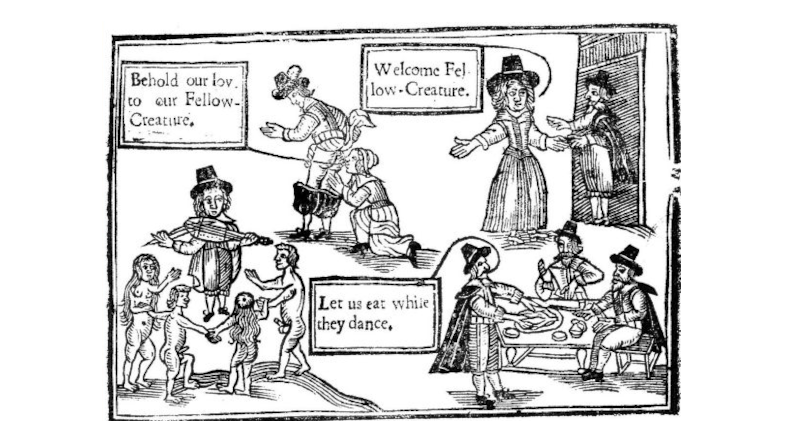
They rejected the literal truth of the Bible, the reality of heaven and hell, the Trinity, and the notion of immorality, maintaining that spiritual salvation existed here on Earth. Ranters believed this would be achieved through nudity, blasphemy, swearing, and profanity, and, most of all, sexual liberty. For the Ranters, sin was a product only of the imagination and private ownership of property was wrong.
Like the Quakers, the Ranters embraced the concept of the Inner Light, but went further by claiming that anyone who had formed a personal relationship with God was no longer bound by conventional society and that whatever was done in The Spirit was justifiable.
The Ranters called for compassion for outcasts – beggars, rogues, and thieves – and for an emphasis on impulse and instinct. They believed any act was good so long as it was done with passion and conviction.
Liberation from all legal and moral restraint
This encouraged a sense of liberation from all legal and moral restraint. Organised forms of religion could be rejected, the concept of sinfulness dismissed, and the Bible itself disregarded. Free love, drinking, smoking, and swearing were regarded as routes to spiritual liberation.
Ranters believed that Christ’s atonement on behalf of humankind was sufficient to save believers to such a degree that they lived in a state of 'free grace'. In other words, the Ranters rejected the authority of the Church of England.
The Ranters had earlier come into contact and even rivalry with the emerging Quakers, who were often falsely accused of direct association with them. One founder of Quakerism, George Fox, wrote in his journal that by the time of the Restoration many Ranters had converted to Quakerism.