| | by admin | | posted on 30th April 2026 | Nonviolent direct action | | views 6 | |
In an age where protest moves at the speed of a scroll, pinning peace turns belief into something that cannot be dismissed or disappeared.
Political expression in the 21st century is immediate, visible, and unstable. A post is shared, a hashtag trends, a profile picture changes. For a moment, alignment is clear. Then the feed moves on. What felt urgent at breakfast is buried by evening.
This is not a failure of intent but a feature of the medium. Digital platforms are built for velocity. They reward novelty, not persistence. Protest becomes a signal that spikes and fades, measured in impressions rather than presence.
The result is a strange paradox. More people than ever can express support for peace, justice, or solidarity, yet that expression rarely settles into something durable. It is seen, but not held. Declared, but not carried.
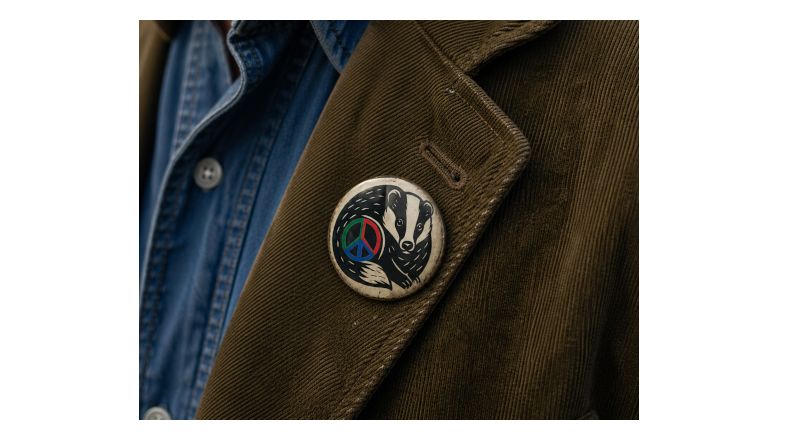
A badge resists this logic. It does not refresh or disappear. It sits where it is placed, held in position by a small piece of metal and a deliberate choice. Once pinned, it becomes part of the body's public surface.
This is where its power lies. A badge is not encountered once but repeatedly. It is seen in the queue, on the bus, across a meeting table. It does not rely on timing or algorithms. It exists in shared space, asking to be noticed or ignored, but never scrolled past.
The act of wearing one is also different. It is slower. It requires a decision not just to agree with an idea, but to carry it into public view. The weight is slight, but it is constant. The message does not vanish when the screen is turned off.
In this sense, a badge turns belief into presence. It makes a position visible over time, not just at a moment.
This is not a new idea. Long before digital networks, small metal badges operated as a form of mass communication. They were cheap, portable, and widely distributed, allowing movements to travel across cities, workplaces, and generations.
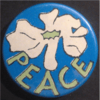
The peace symbol itself was designed in 1958 by Gerald Holtom for the Campaign for Nuclear Disarmament. Crucially, Holtom never copyrighted the design. It was intended to spread freely, to be reproduced, adapted, and worn without restriction. That decision allowed it to move rapidly from marches to everyday life, appearing on badges, clothing, and posters across the world.
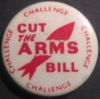
Throughout the second half of the 20th century, badges became part of the visual language of protest. Trade union members, anti-apartheid campaigners, anti-war demonstrators, and community organisers all used them as markers of alignment. A badge could identify a cause, but it could also identify a person within that cause.
They were, in effect, an earlier form of network. Not digital, but physical. Not instant, but persistent.
What defined many of these badges was their specificity. Alongside universal symbols like the peace sign, there existed countless variations that tied the cause to particular identities: workers, parents, teachers, veterans.
This layering matters. A general call for peace can be dismissed as abstract. A badge that reads 'Nurses for Peace' or 'Grandads Against the Bomb' is harder to ignore. It anchors the idea in lived experience. It says: this is not an external issue, but something that reaches into everyday life.
The shift toward what might be called micro-identity does not fragment a movement. It strengthens it. Each variation becomes a point of entry, allowing people to see themselves reflected in the cause. It also reshapes how the message is received. A plea for peace spoken by a stranger is one thing. The same plea carried by a colleague, a neighbour, or a fellow passenger carries a different weight.
In this way, badges operate not just as symbols, but as bridges. They connect abstract ideals to recognisable lives.
To understand the continued relevance of badges, it helps to look at how they function in ordinary settings. They are not confined to protests or rallies. They move through everyday environments: supermarkets, buses, workplaces, streets.
In these spaces, a badge creates a quiet form of visibility. It does not demand attention, but it allows recognition. Two people who might otherwise pass without acknowledgement can register a shared position. Sometimes this leads to conversation. Sometimes it remains unspoken. Both outcomes matter.
There is also an element of exposure. To wear a badge is to accept a degree of risk, however small. It signals a stance that others may question or challenge. This is part of its meaning. The badge is not just a statement of belief, but a willingness to be seen holding that belief in public.
This combination of repetition, visibility, and mild risk gives the object a durability that digital expression struggles to match. It embeds the message into the rhythms of daily life.
Badge culture has not disappeared. It has thinned, shifted, and adapted, but it remains present. Collections held at places such as The Peace Museum in Bradford show the depth and range of this tradition, from mass-produced campaign badges to highly specific, locally made variations.
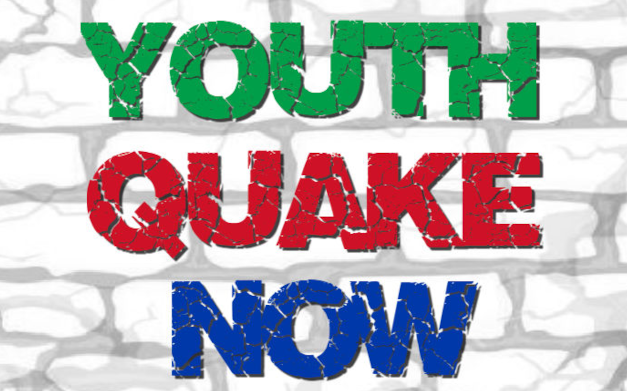
Contemporary projects are beginning to draw on this history, reworking familiar symbols and introducing new ones. In some cases, artists have scaled badge designs into large public works, translating a one-inch object into something that occupies an entire wall. This movement between scales highlights the underlying idea: that even the smallest surface can carry a significant message.
What is emerging is not a nostalgic return, but a continuation. The badge remains a flexible form, capable of adapting to new contexts while retaining its core function as a visible marker of alignment.
In a culture defined by speed and turnover, the most radical gesture may be one that slows things down. A badge does not compete for attention in the way a post does. It does not need to. Its strength lies in staying.
Pinned to a lapel or a bag, it becomes part of a person's daily presence in the world. It travels through spaces where digital messages cannot reach in the same way. It is seen not once, but again and again, by different people in different moments.
This is how small objects build influence. Not through scale or spectacle, but through repetition and recognition. Over time, they create a visible network of individuals who carry the same idea into shared space.
A badge does not resolve conflict or end war. Its role is quieter than that. It marks a position, holds it in place, and allows it to be seen. In doing so, it turns belief into something that endures beyond the moment in which it is declared.