| | by admin | | posted on 27th April 2026 | Symbols | | views 0 | |
The Eiffel Tower Peace symbol turns a simple drawing into a global sign of solidarity, where an idea of peace emerges from a moment of violence.
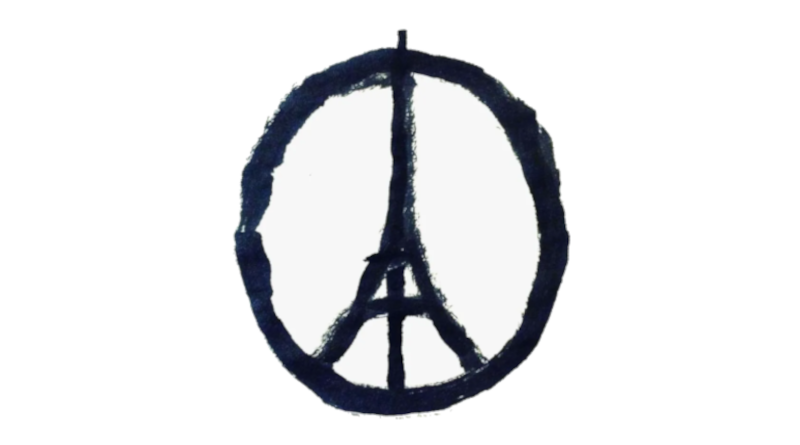
The Eiffel Tower Peace symbol is immediately recognisable. It takes the familiar circular form of the peace sign and replaces its central vertical line with the silhouette of the Eiffel Tower. Drawn in bold, rough strokes, it looks almost unfinished, as if made in haste rather than design. That simplicity is part of its meaning.
By combining a universal symbol with a specific place, the image creates a direct emotional link. Peace is no longer abstract. It is located. It belongs to a city, to people, to a moment. The symbol carries an idea that peace can be expressed not only as a principle, but as a response — something that appears when it is needed most.
The symbol was created in November 2015 by French graphic artist Jean Jullien in the immediate aftermath of the Paris attacks. Rather than producing a detailed illustration, he sketched a simple mark in black ink and shared it online within minutes. It was not presented as a finished artwork, but as an instinctive reaction to events.
This origin matters. The image was not designed through a process of refinement or commission. It emerged quickly, shaped by urgency rather than intention. That gives the symbol its particular character. It feels less like a crafted object and more like an idea made visible at the exact moment it was needed.
Once shared, the image spread rapidly across social media. It was reposted, redrawn and reproduced in countless forms, appearing on posters, in vigils and in public spaces across the world. Within hours, it had moved beyond its creator, becoming something collectively held rather than individually owned.
This is where the drawing became a symbol. Its meaning did not depend on explanation. People recognised the combined forms and understood the message instantly. The peace sign anchored the idea, while the Eiffel Tower located it in Paris. Together, they allowed individuals far from the city to express solidarity in a shared visual language.
In this way, the symbol functioned as a tool for collective response. It offered a way to participate without words, to signal care without argument. The idea of peace was not debated or defined. It was simply shown, repeated and recognised across distance.
The Eiffel Tower Peace symbol remains significant because it shows how quickly an idea can take form. Unlike older symbols that develop over decades, this one emerged almost instantly, shaped by the speed of digital communication and the urgency of the moment. It demonstrates that symbols do not always grow slowly. Sometimes they appear all at once.
It also reveals something about the nature of peace as an idea. Here, peace is not presented as a settled condition, but as a response to disruption and loss. The symbol does not resolve conflict. It acknowledges it, and then answers it with a gesture of unity.
The lasting power of the image lies in its simplicity. Anyone can draw it. Anyone can recognise it. In that sense, it continues to function as an open symbol, one that carries the idea that peace can be shared quickly, widely and without permission when it is most needed.