You Can't Sink a Rainbow
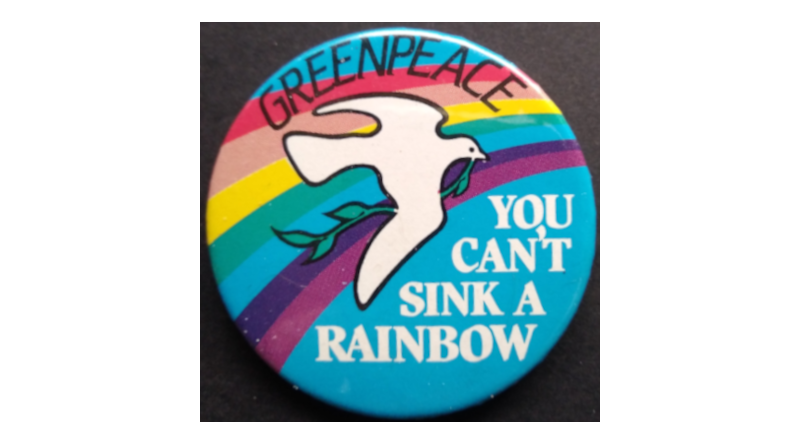
You can't sink a rainbow> is a brightly coloured badge that was worn as a simple play on words — a moment of destruction into a statement of steadfast resolve.
In July 1985, the Greenpeace flagship, the Rainbow Warrior, sat docked in Auckland harbour, New Zealand. The crew was preparing to protest French nuclear testing at Moruroa Atoll. Late one night, French intelligence agents attached two limpet mines to the hull beneath the waterline.
The resulting explosions tore through the metal, sinking the ship in a matter of minutes and killing Portuguese photographer Fernando Pereira. The attack was a state-sponsored attempt to halt a protest by sending its vessel to the seabed.
The weight of a rainbow
Instead of ending the campaign, the bombing provided the movement with a phrase that would haunt the French government for decades. The badge itself captures this defiant response. Against a bright blue background, a white dove carrying a green olive branch flies across a bold, five-colour rainbow.
The printed slogan operates on a stark material contradiction. A ship is built from heavy components like steel, wood, and engine blocks. If its hull is breached, gravity and water will inevitably pull it down. A rainbow, however, has no solid mass. It is nothing more than light refracting through moisture in the air. By the strict laws of physics, it is impossible to sink.
By destroying the tangible vessel, the attackers only managed to liberate the idea behind it. The badge asserts that the principles of the environmental movement are as untouchable as light in the sky.
Words from the street
A phrase this sharp might seem like the work of a professional advertising agency, but it actually came from the street. The slogan was coined by an anonymous supporter in New Zealand immediately after the bombing.
Greenpeace organisers spotted the line—likely written on a handmade protest sign or a note of condolence—and realised it captured the exact reality of the moment. They adopted it immediately. It demonstrated that the movement's most effective responses came not from public relations professionals, but directly from grassroots observers.
A larger vessel
The defiant message of the badge proved accurate. Rather than deterring activists, the attack backfired entirely. The bombing created a global diplomatic scandal and fuelled a massive surge in public donations.
Greenpeace used those funds to purchase a much larger, stronger successor ship to continue their methodical work on the oceans. When the new vessel finally set sail, it was christened with the exact same name: the Rainbow Warrior II.