
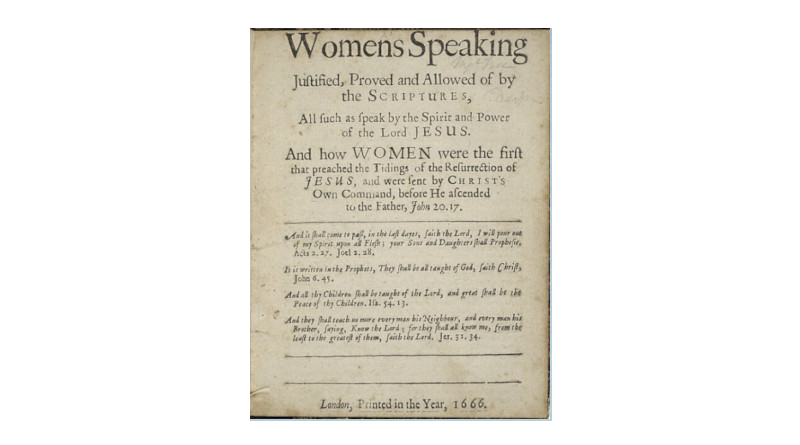
Women's Speaking Justified pamphlet
The Women's Speaking Justified pamphlet, published in 1666 by the Quaker Margaret Fell (1614 - 1702), is one of England's earliest texts on the subject of feminist theology.
Proved and allowed
Margaret Fell, a founding figure of the Society of Friends, published her pamphlet with the full title of Women's Speaking Justified, Proved and Allowed of by the Scriptures.
The pamphlet's importance is that it defends women's spiritual and public voices at a time when such defence was rare. Fell's writing achieves this not through secular reasoning but through scripture, challenging the theological basis for women's silence.
Fell wrote at a time when English society was overwhelmingly patriarchal. Women were expected to stay silent in public and invisible in the pulpit.
The prevailing interpretation of 1 Corinthians 14:34 was based on the instruction: “Let your women keep silence in the churches”. It was used to bar women from preaching or exerting spiritual authority. Yet the Quaker movement, radical in its egalitarianism, had already begun to upend this structure.
In Quaker belief, The Spirit speaks directly to all people, regardless of gender, status, or education. Fell put this practice into writing.
The mother of Quakerism
Sometimes called the 'Mother of Quakerism', Fell was uniquely positioned to defend women's ministry. As the wife of Judge Thomas Fell and later of George Fox, the movement's co-founder, she was well educated and immersed in the theology and persecution of early Friends.
Women's Speaking Justified was her spirited rejoinder to those who used scripture to silence women.
Fell's central claim was as simple as it was revolutionary for the 17th century. Women may and must speak when The Spirit moves them. To argue this, she examines the New Testament, highlighting instances where women were not only allowed, but divinely commissioned, to speak.
A scriptural defence of women's ministry
Among her evidence, she points to Mary Magdalene, the first to witness the resurrected Christ, who was commissioned to tell the others.
She invokes the words of Joel, quoted by Peter in Acts: “I will pour out my spirit upon all flesh… and your sons and your daughters shall prophesy.”
Fell insists that to deny women's speech is to deny the activity of the Holy Spirit, which “knows no such bounds of male or female, bond or free.” This was a profound assertion in a time when women's words were considered suspect, emotional, and untrustworthy by default.
Legacy of a proto-feminist work
Though Fell never used the language of modern feminism, her argument sits close to it. Her writing is a defence of women's agency, their spiritual equality and their right to shape religious life. The prose is grounded not in male approval, but in divine inspiration and reasoned scripture.
In this way, the pamphlet prefigures later feminist theology, standing as one of the first works by a woman in English religious scholarship to defend women's voice in public life.
Not widely recognised in mainstream histories of feminism, the pamphlet has nonetheless had a quiet, enduring influence and is treasured among Quakers as a foundational text for gender equality.
Studied today as one of the earliest expressions of Christian feminist thought, Margaret Fell's work reminds the modern reader that the struggle for women's equality has deep roots, even in times and places where it seemed unthinkable.
The Women's Speaking Justified pamphlet stands as a testament to spiritual courage, intellectual rigour, and the enduring power of the spoken word — even, and especially, when spoken by a woman.