
Wet Quakers illustration
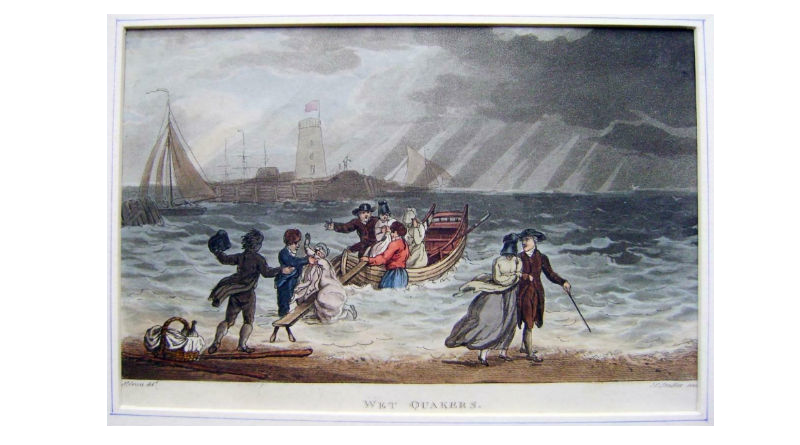
The Wet Quakers illustration, drawn in 1812, shows how Friends were mocked in the 19th century, and how that mockery was reclaimed as part of an enduring identity.
James Green and Scarborough
The painted illustration is by James Green (1771 - 1834), a portrait painter that exhibited at the Royal Academy. His on-the-spot sketches of Scarborough were later etched into engravings by Thomas Rowlandson, and published by Rudolph Ackermann.
He visited the English coastal town of Scarborough by stagecoach in 1812. During his stay he made a series of sketches of interesting scenes in the town which he later made up into watercolours.
The following year, Rowlandson turned Green's watercolours into engravings, published in the book Poetical Sketches of Scarborough (1813), of which Wet Quakers is one of 21 illustrations.
Mockery
At first glance, the image reads like a comic seaside scene. A group of plainly dressed Friends struggle ashore in wind and spray. Clothes cling, hats are battered by weather, and the figures look dignified yet awkward, serious yet drenched.
This is not devotional art. It is satire. The humour depends on visibility. Quakers were instantly recognisable by plain dress, sober bearing, and the small social refusals that marked them out in public life.
In a culture attentive to rank and ceremony, Friends were mocked for refusing hat-honour, for continuing to use 'thee' and 'thou', for refusing oaths, and for rejecting violence. Strangeness invites laughter, and the engraving trades on that recognisable difference.
Endurance and reclamation
Mockery, however, was nothing new for the Society of Friends. The very name 'Quaker' began as a sneer, thrown at early Friends who were said to tremble under the power of God's Spirit. In time, it became the name they wore themselves.
Friends were ridiculed in marketplaces, attacked in print, fined, and imprisoned. Their refusal to conform made them conspicuous, and at times unwelcome. And still they did not retreat.
Plainness became testimony. Refusing hat-honour became a lived sign of equality before God. What outsiders mocked as stubbornness was experienced inwardly as faithfulness. The figures in Green's engraving may be soaked, but they remain together, helping one another, still recognisably Friends.
Steadfastness of faith
Many modern Quakers would not be offended by this illustration. Some might quietly enjoy it. A few might wince at the stereotype. But many would recognise something familiar — not in the wet coats, but in the persistence.
Friends are still sometimes thought peculiar, still occasionally misunderstood, still described in ways that miss the inward life. Yet the pattern remains. Friends are still visibly different, still steady in their witness, and they still refuse to be reshaped by ridicule.
James Green likely intended his Wet Quakers illustration to capture an amusing moment from Scarborough life. But the image also testifies to something the artist may not have intended, which is steadfastness of faith.
The sea could drench their coats. It could not wash away their identity.