
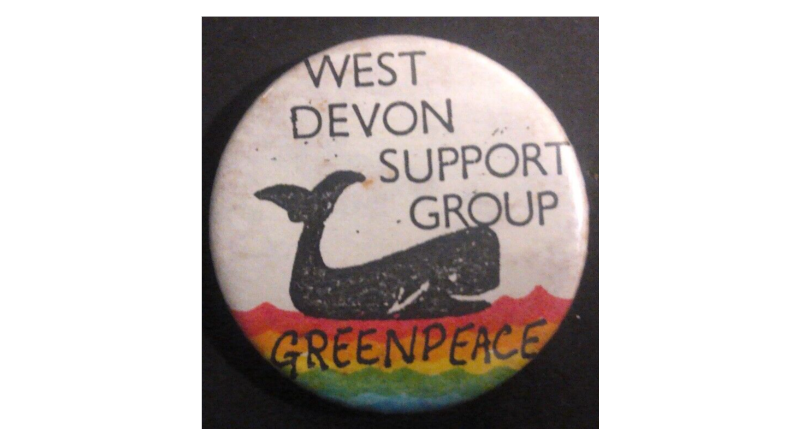
West Devon Support Group
West Devon Support Group is a vintage pin badge by Greenpeace that connects the quiet work of a rural English community to a distant struggle in the deep ocean.
The autonomous network
West Devon is a predominantly rural district in South West England, defined by the rugged expanse of Dartmoor and quiet market towns. During the late 1970s and 1980s, Greenpeace reached into communities exactly like this one through a decentralised network of local support groups.
These autonomous groups were the financial backbone of the UK campaign, raising funds locally to send back to the central organisation. Because they operated independently, they frequently commissioned their own unofficial merchandise.
A creature of the deep ocean
The sperm whale on the badge was a deliberate statement of long-distance solidarity. It was not an animal the volunteers could see from their own shores; it would be an exceptionally rare sight anywhere near the Devon coast.
Sperm whales are creatures of the deep, built for the immense pressure and darkness of submarine canyons far out on the continental shelf where they hunt giant squid. Their world is the vast, open ocean, a habitat entirely separate from the fields and moors where this badge was being sold.
By choosing this animal, the West Devon group was not campaigning to protect local wildlife. They were bearing witness for a creature living in an unseen world, thousands of miles away.
Rainbow waves
Beneath the whale, the hand-coloured waves of red, orange, and yellow are a direct nod to the Greenpeace's most recognisable symbol. During this era, the rainbow was inseparable from the organization's identity, carried across the globe by their famous flagship, the Rainbow Warrior.
Along with the whale, this specific imagery firmly roots the badge in the late 1970s or early 1980s, at the absolute peak of the 'Save the Whales' campaign. It was a straightforward way for a local group to show they were part of the wider international effort.
Connected by the sea
The persistent pressure from Greenpeace's combined land and sea campaigns eventually pushed commercial whaling to the margins of international law. The high-profile struggle of that era has since evolved, and the early support groups have become part of a different kind of digital network.
West Devon Support Group survives as a link between a local Greenpeace organisation, based on England's southern coast, and the international campaign to 'save the whales' — both connected by the sea.