
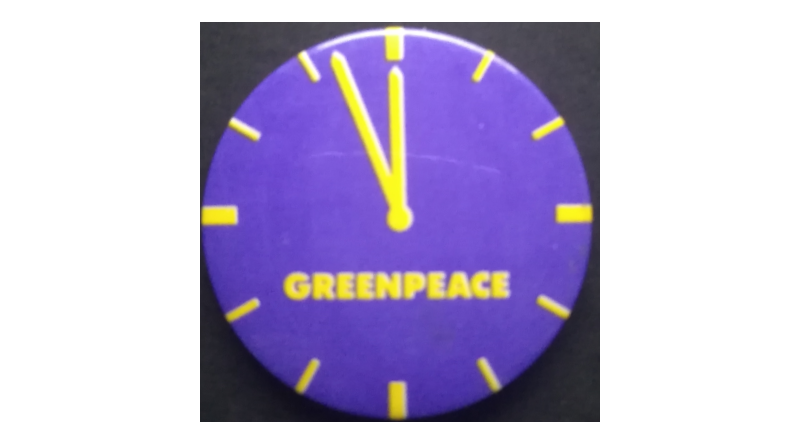
Three minutes to midnight
Three minutes to midnight is a vintage peace badge by Greenpeace that uses a ticking clock to symbolise the urgency of environmental action.
A clock born in the Cold War
The image has its roots in the Cold War, when midnight stood for nuclear annihilation. During the 1980s, Greenpeace positioned itself at the intersection of anti-nuclear protest and environmental defence, arguing that global survival had become a matter of time as much as principle.
The idea drew directly on the Doomsday Clock, created by the Bulletin of the Atomic Scientists. In 1984, that clock stood at three minutes to midnight, its closest position to catastrophe since 1953.
Greenpeace borrowed the clock's language but widened its reach. The oceans, the atmosphere, and the human future were folded into the same countdown, treated as different faces of the same running clock.
When protest met real risk
The danger was not only symbolic. In July 1985, French secret service agents bombed the Rainbow Warrior in Auckland Harbour as Greenpeace prepared to protest against French nuclear testing in the Pacific. Photographer Fernando Pereira was killed in the attack.
The bombing showed that the clock's warning carried a real cost. It placed activists in direct conflict with state power, not simply in a battle over messaging.
This moment revealed something central to the symbol's meaning. Midnight was not only a warning about what might happen. It was already shaping what people were willing to do in the present, including the risks they were prepared to take to slow its approach.
The shift towards climate
By the late 1980s, Greenpeace began turning the same symbol towards a different threat. As Cold War tensions eased, climate change emerged as a danger that operated differently from nuclear war but carried comparable consequences. It was slower, less visible in any single moment, yet capable of reshaping the planet.
This shift did not replace the original meaning but expanded it. Midnight no longer referred only to sudden destruction. It also came to describe a slower crossing of thresholds, where damage builds until it can no longer be undone.
From metaphor to measurement
By the late 2010s, the same clock imagery gained new precision as climate science supplied measurable limits. Campaigners increasingly tied the countdown to carbon budgets and the 1.5°C target, turning a symbolic warning into a quantified one.
Public climate clocks, created separately by artists and scientists, made this visible in cities worldwide. Installed in public spaces, they displayed how long remained before the global carbon budget would be exhausted.
Time was counted down in years, days, and seconds rather than left abstract. Greenpeace pointed to the clocks as evidence that delay was no longer easy to ignore.
A campaign of pressure and action
As the deadline narrowed, Greenpeace's approach became more confrontational. It combined public messaging with legal action, lobbying, and direct protest. The focus shifted from raising awareness to pressing for change.
The Global Ocean Treaty, which entered into force in January 2026, was presented as an example of time being gained. It does not automatically protect 30% of the oceans, but it creates a legal pathway towards that goal.
Meanwhile, protests against fossil fuel expansion have intensified. Activists argue that every new project pushes the deadline closer.
What the countdown demands
The strength of the clock as a symbol lies in its simplicity. It translates complex science into a basic human experience, the sense that time is running out. That shift changes how responsibility is understood.
Greenpeace now links the countdown to clear demands: that polluters pay for the damage they have caused, that governments pursue real emissions cuts rather than relying on offsets, and that younger generations are given a decisive voice.
Midnight is not presented as inevitable. It is a deadline shaped by action or inaction.
Across decades, the meaning of Three minutes to midnight has changed, but its purpose has remained consistent. It does not predict the future with certainty. It reframes the present, asking how much time remains and what will be done before it runs out.