
| | by admin | | posted on 24th March 2026 | Artworks | | views 640 | |
The Third of May 1808 shows an execution turned into a moment where a single exposed figure confronts organised violence.
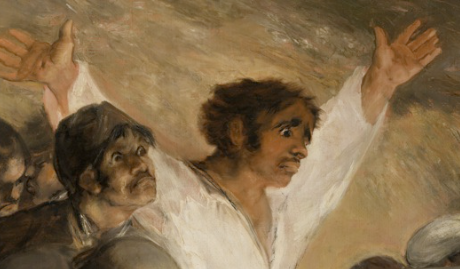
Painted in 1814, The Third of May 1808 is a large-scale oil painting on canvas measuring 268 cm by 347 cm, by (1746 – 1828) . It presents a night-time execution on the outskirts of Madrid, where a group of prisoners gathers on uneven ground facing a line of soldiers with rifles raised and aligned. A lantern placed between them casts a hard, focused light, illuminating the central figure in a white shirt whose arms are raised and whose body is fully exposed.
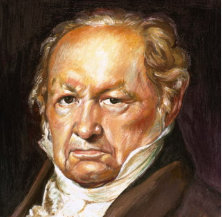
Goya was a Spanish court painter who later turned toward darker, more direct images of violence and human experience. Here, he arranges the scene with clarity. The soldiers form a tight, unified block, their backs turned, their faces unseen. The prisoners are disordered, some standing, others collapsing or already fallen. At the centre, one man separates from the rest, held in the instant before the rifles fire.
The painting responds to the events of 1808, when the Peninsular War brought French troops into Spain and sparked uprising in Madrid. Reprisals followed quickly. Civilians were rounded up and executed, often in groups, often without ceremony. Goya returned to these events after the war had ended, producing an image that does not commemorate victory but records a moment of killing.
The composition removes the scene from heroic tradition. There is no battlefield, no movement, no sense of exchange between opposing sides. The soldiers do not act as individuals but as a single mechanism, their bodies angled forward in identical formation. The rifles extend in parallel, creating a flat edge across the painting. The act of violence is organised, impersonal, and carried out without recognition.
Against this structure, the central figure remains fully visible. His white shirt catches the lantern light, making him the brightest point in the painting. His arms are raised, not in defence but in exposure, his body opened rather than shielded. His face is turned outward, held in the act of seeing and being seen.
This is a firing squad transformed into a machine, and a victim made impossibly visible.
The man does not interrupt what is about to happen. The line of soldiers holds, the aim is fixed, the outcome is certain. Yet his presence changes the terms of the scene. He cannot be reduced to the same order as the rifles directed toward him. Where the soldiers are unified and faceless, he is singular and exposed. The contrast does not stop the violence, but it prevents it from becoming neutral.
The shot has not yet been fired. The painting fixes itself in that suspended instant, where everything is in place but nothing has yet resolved. The space between the soldiers and the man remains open, stretched by the imbalance between them.
This is why the image has endured. It does not rely on the specifics of 1808, or even on Spain. It presents a structure that can be recognised again and again: organised force facing an exposed individual, a system set against a person who cannot be fully absorbed into it.
Later artists return to this structure, whether consciously or not. The faceless line of authority, the illuminated figure, the held moment before impact - these elements reappear wherever violence is examined rather than celebrated. The painting becomes less a record of a single event and more a way of seeing.
The rifles will fire, but the image does not move forward with them. It remains with the figure who stands in the light, present and exposed, refusing to disappear before the violence that will take him.