The Florida scrub jay: Living within limits
The Florida scrub jay lives within a narrow band of land and fire, showing how survival can depend on conditions that must be carefully maintained rather than left alone.
A bird bound to one place
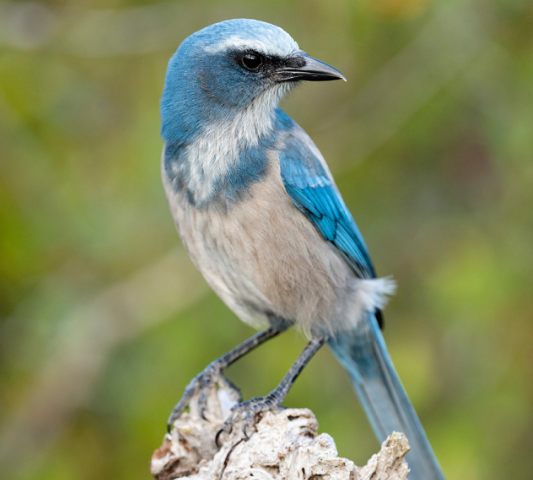
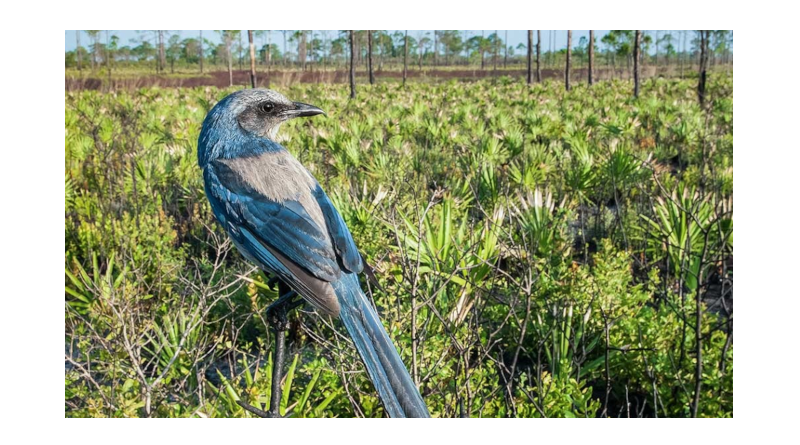
The Florida scrub jay (Aphelocoma coerulescens) is the only bird species found entirely within the state of Florida. It does not migrate, does not expand outward, and does not adapt easily to new environments. Instead, it remains tied to a specific kind of landscape: low, open scrubland shaped by sandy soil and scattered oak. Its range is not just limited geographically but ecologically, confined to conditions that exist only in fragments across a single region.
This makes the scrub jay less a wandering species than a resident of a precise world. Where that world persists, the bird endures. Where it disappears, the bird cannot simply relocate. Its survival is inseparable from the continued existence of the habitat it depends upon.
There is also a particular quality to this dependence. Many species move in response to change, shifting range or behaviour as conditions alter. The scrub jay does not. It remains within its limits, relying on the persistence of a landscape that must remain recognisable to it. In this sense, it is not only a bird of place but a bird of continuity.
A landscape shaped by fire
The habitat of the Florida scrub jay is not stable in the usual sense. It relies on periodic fire to remain viable. Without fire, scrubland grows dense and tall, closing the open spaces the birds require. Oaks rise, shade spreads, and the structure of the land shifts beyond what the species can use.
Fire, in this context, is not destruction but renewal. Historically, lightning strikes would move through these dry landscapes, resetting growth and maintaining a mosaic of low vegetation. Today, controlled burns attempt to recreate this cycle, keeping the scrub within the narrow height and openness the birds need.
This introduces a paradox. The continued presence of the scrub jay depends not on leaving nature untouched, but on intervening within it. Preservation alone is not enough. The land must be actively tended in order to remain what it is. Without that care, the habitat remains visible, but no longer functions for the species that depends upon it.
Living in families
Within this constrained environment, scrub jays organise themselves into extended family groups. Young birds often remain with their parents beyond a single breeding season, helping to raise subsequent broods. They act as lookouts, share feeding duties, and contribute to the survival of the group as a whole.
This cooperative breeding is not simply a behavioural curiosity. It reflects the limits of the landscape. Suitable territory is scarce, and opportunities to disperse are restricted. Rather than moving on, individuals remain and contribute, forming stable, multi-year family units rooted in place.
These groups depend on space. Each family requires a territory large enough to support foraging, nesting, and caching food. When that space is available, the structure holds. When it is reduced or fragmented, the balance becomes harder to maintain. The social life of the species is therefore inseparable from the physical continuity of its habitat.
A fractured world
Over the past century, much of Florida’s scrub habitat has been reduced or divided by development, agriculture, and road networks. What remains is often broken into smaller, disconnected patches. For a species that rarely travels far from where it is born, this fragmentation creates a quiet but significant barrier.
Young birds leaving their family groups must find unoccupied territory. In a continuous landscape, this is possible. In a fragmented one, it becomes uncertain. Suitable habitat may exist nearby, but if it is separated by roads, buildings, or unsuitable terrain, it may as well be unreachable. Populations become isolated, and movement between them declines.
At the same time, the suppression of natural fire cycles alters the structure of the remaining habitat. Scrub that once remained low and open grows taller and denser. Even where land is still present, it may no longer be usable. The result is a double constraint: less space, and less of it in the right condition.
The decline of the Florida scrub jay is therefore not driven by a single event, but by the gradual reorganisation of its world. The landscape persists, but no longer in a form the species can inhabit with ease. Continuity is broken not only in space, but in function.
Law, land, and limits
In recent years, the future of the Florida scrub jay has also been shaped by legal debate. A court challenge in the United States has questioned whether a species found entirely within one state should fall under federal protection. The argument turns on the reach of national law, suggesting that species confined to a single region may lie beyond it.
This is not simply a technical question. Federal protection under the Endangered Species Act has played a significant role in conserving remaining habitat and supporting recovery efforts. If such protection were weakened or removed, responsibility would shift unevenly, and conservation measures could become more difficult to sustain.
The case introduces a further layer of uncertainty. The scrub jay is already limited by geography and ecology. It now faces the possibility that the legal structures supporting its survival may also be reconsidered. A species bound to one place becomes, in this sense, vulnerable not only to environmental change, but to shifts in how protection itself is understood.
What the scrub jay shows
The Florida scrub jay offers a way of understanding life within limits. It does not expand beyond its conditions, nor reshape them to its advantage. Instead, it exists within a narrow set of relationships between land, vegetation, and fire, each one necessary to the others.
Its vulnerability lies not in weakness, but in precision. The conditions it requires are exact, and when those conditions are altered, even slightly, the effects accumulate. The world it depends upon can remain visible while becoming, gradually, uninhabitable.
In this sense, the scrub jay suggests that survival is not always a matter of adaptation or control, but of balance. The conditions that sustain life may require attention, restraint, and care over time. Peace, in this frame, is not passive. It is the ongoing work of keeping a world inhabitable.