| | by admin | | posted on 25th April 2026 | Symbols | | views 15 | |
Picasso's Dove reduces a living bird to a few lines, where an idea of peace becomes simple enough to share.
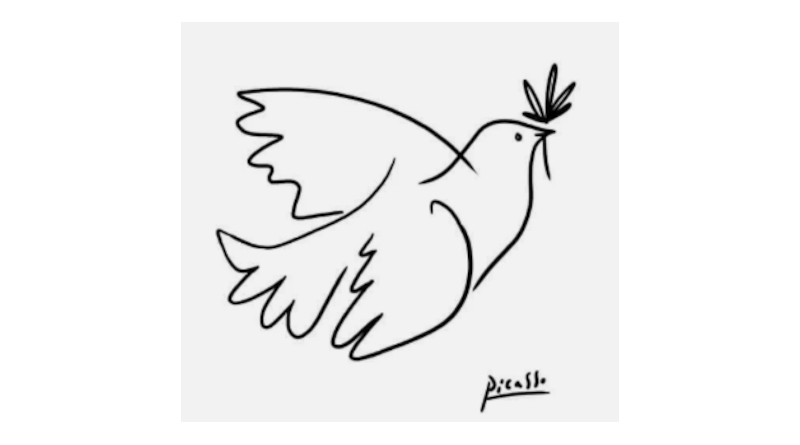
Picasso's Dove, in its most widely recognised form, is not a detailed image but a line drawing. The bird is outlined in a few continuous strokes, its body soft and rounded, its wings open, often carrying a small olive branch. There is no shading, no background, and no attempt at realism beyond what is necessary to recognise the form. The simplicity is deliberate.
This reduction gives the image its strength. By stripping the dove back to its outline, Picasso transforms it into something more than a picture. It becomes a symbol that can be repeated easily and understood instantly. The meaning does not rely on detail. Instead, the drawing carries an idea of peace that feels open, gentle and widely accessible.
The line drawing has its origins in an earlier work. In 1949, Picasso created a lithograph of a white dove that was selected as the emblem for the Paris Peace Congress. That original image was more naturalistic, based on a real bird, and carried a quiet sense of stillness and clarity. It marked a moment in the aftermath of the Second World War when peace was being actively imagined on an international scale.
From that starting point, Picasso began to simplify the image. The detailed bird became a drawn outline, the form reduced to its essential lines. This shift is what matters. The image moved from being an artwork to becoming a symbol. It no longer depended on printmaking or context. It could exist anywhere, carried by the hand as much as by the press.
Once simplified, the dove spread quickly through peace movements across Europe and beyond. It appeared on posters, banners and publications linked to international peace campaigns. Because it was easy to reproduce, it could be copied, adapted and redrawn without losing its meaning. The image did not remain tied to Picasso as an artist. It became something shared.
This is the point at which the dove became more than a representation of peace. It became a tool for expressing it. People could draw it themselves, print it, carry it, or display it in public. The idea of peace was no longer contained within a single image. It was repeated through use, gaining strength as it moved.
At the same time, the symbol carried political weight. It was closely associated with post-war peace movements, some of which were linked to Cold War tensions and competing ideologies. This did not weaken the symbol, but it did shape how it was seen. The dove was not entirely neutral. It reflected a particular moment in which the meaning of peace was actively contested.
Picasso's Dove endures because it shows how an image can become an idea through simplification. By reducing the bird to a few lines, Picasso made it possible for the symbol to travel. It could move across borders, languages and movements without needing explanation. Its meaning remained clear even as its context changed.
The symbol also continues to work because it feels human. It looks hand-drawn, as though it could be made quickly in response to a moment. That quality keeps it connected to everyday expression, rather than separating it as a distant artwork. Peace, in this form, is not only something represented. It is something people can take part in showing.
In this way, Picasso's Dove bridges the space between art and use. It begins as an image, becomes a symbol, and continues as an idea carried through repetition. A few lines form a bird, and the bird carries a meaning that remains widely understood: peace as something that can be shared, recognised and made visible again and again.