| | by admin | | posted on 23rd April 2026 | Artworks | | views 9 | |
The Dove (1949) reduces a long symbolic tradition of peace and renewal into a form built to travel.
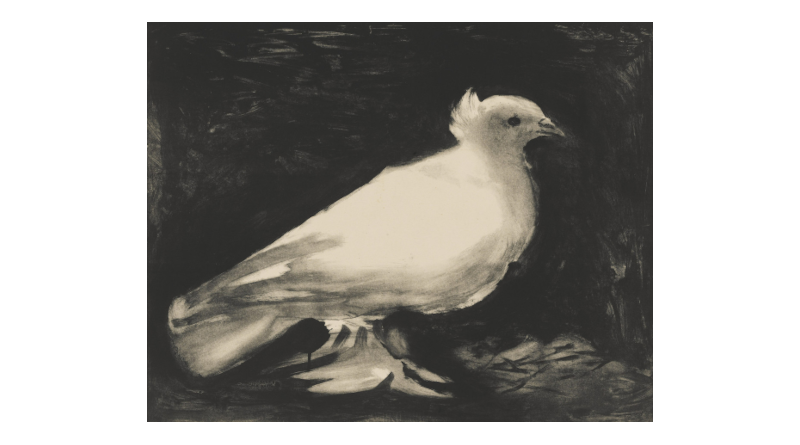
Printed as a lithograph, 55 × 69 cm, the image shows a white dove in profile with its body defined by soft tonal modelling and minimal line. The form is clear but not rigid, with subtle variation in shading that gives the figure weight and presence. There is no setting, no movement beyond a suggestion of stillness. The composition is reduced, but not abstracted, allowing the bird to remain both recognisable and materially grounded.
Pablo Picasso produced the image in 1949, drawing on a long tradition in which the dove carried associations with peace and renewal. His treatment does not invent the symbol but compresses it. The tension lies in the reduction itself: a complex symbolic history is held within a form that can be easily seen, remembered, and repeated.
The lithograph was created for the International Peace Congress held in Paris in 1949, at a moment when the world was emerging from the Second World War and entering the early Cold War. The need for a shared visual language was acute. Nations were divided, but the desire to avoid another global conflict remained widely felt. The image was used on posters and materials linked to the congress, giving it an immediate public role.
Picasso's position added pressure. Having lived through war in Spain and occupation in France, and aligned with left-wing political movements, he was already associated with anti-war imagery through works such as Guernica. Here, the approach shifts. Rather than depicting destruction, the image offers a single, stable form that can circulate without the weight of a specific event.
The image does not begin as a universal symbol. It becomes one through reproduction. Printed for the congress and carried across posters and publications, the dove begins to move beyond its initial setting. Each reproduction reduces the distance between the artwork and its use, allowing the image to be seen in different places and by different audiences.
Within this process, certain qualities become decisive. The clarity of the outline, the balance of the form, and the absence of background allow the image to remain legible as it travels. The lithograph holds enough detail to remain an artwork, but enough simplicity to be repeated without losing its identity.
The dove holds its shape as it moves into wider use. It does not yet function as a fixed symbol, but it creates the conditions for one. The image can be printed, copied, and adapted while remaining recognisable, allowing it to pass between contexts without requiring explanation.
What remains is the form itself. A single figure, reduced but not emptied, begins to circulate beyond its point of origin. The image does not resolve into a final meaning. It opens into use, and into meaning shaped by those who carry it.