| | by admin | | posted on 29th March 2026 | Artworks | | views 35 | |
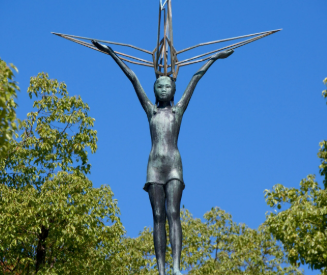
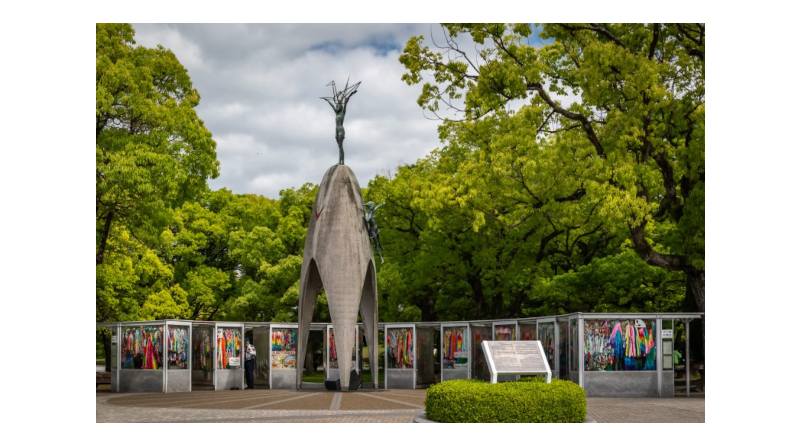
The Children's Peace Monument (1958) raises a child above Hiroshima, holding a crane in a gesture that turns memory into a call for peace.
A young girl stands elevated above the ground, her arms lifted high as she holds a paper crane above her head. Her body is slender, almost weightless, the upward gesture drawing the eye toward the sky rather than back toward the earth below. Beneath her, a stone pedestal rises to support the figure, while smaller child figures stand at its base. The monument reaches approximately nine metres in height, combining bronze and stone to create a vertical structure that feels both grounded and lifted at once. Around it, glass cases fill with folded paper cranes, their colours constantly shifting as new ones are added.
The monument was designed by Kazuo Kikuchi and collaborators, and stands within Hiroshima Peace Memorial Park. It was created not as an isolated artwork, but as part of a wider landscape of remembrance shaped by the events of 6 August 1945.
The monument is closely associated with Sadako Sasaki, who was two years old when the atomic bomb was dropped on Hiroshima. A decade later, she developed leukaemia as a result of radiation exposure and, during her illness, began folding paper cranes. According to Japanese tradition, folding one thousand cranes grants a wish. Sadako's wish was for recovery and for peace, but she died in 1955 at the age of twelve.
Her classmates, moved by her death, organised a campaign to build a memorial not only for Sadako, but for all children who had died as a result of the bombing. Contributions came from thousands of schools across Japan and beyond, and the monument was unveiled in 1958 as a collective act of remembrance. The act of folding cranes, begun as a personal gesture, became something larger, carried forward by others.
The monument does not stand alone. It is surrounded by the continuous presence of paper cranes, sent by children and visitors from across the world. These cranes are not fixed in place but constantly renewed, creating a shifting field of colour and intention. Each one represents a small, repeatable act, a gesture that connects individual memory to a wider desire for peace.
This ongoing participation gives the monument a different kind of life. It is not only something to be seen, but something that continues through the actions of others. The act of folding cranes has been carried into other peace works, including the One Thousand Cranes sculpture in Seattle's Peace Park, which is in part inspired by the Children's Peace Monument.
“This is our cry. This is our prayer. To build peace in the world.”
The words do not describe the past so much as direct attention toward the future.
The monument holds a memory, but it does not complete it. The figure remains fixed in bronze, yet the cranes around it continue to arrive, carrying new intentions into the same space. What began with one child's act has become something that others repeat, not as imitation, but as continuation.
The meaning of the monument does not rest in the figure alone, but in what happens around it. Each crane extends the gesture forward, placing responsibility not in the past, but in the present.