
Stop the repression trade
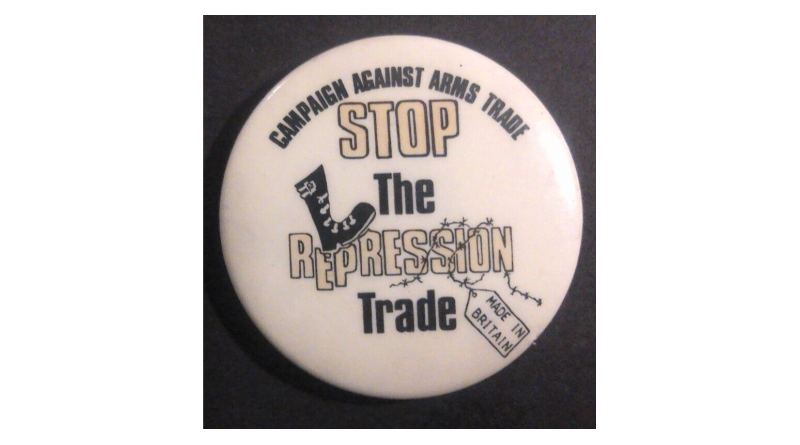
Stop the repression trade is a Campaign Against Arms Trade (CAAT) vintage pin badge that makes a direct accusation against the British government's role in the global arms market.
A boot, a wire, and a price tag
The badge is a carefully designed piece of visual evidence. On a plain, off-white background, the message is laid out in stark black-and-beige ink. A heavy combat boot is shown stamping down on the word 'REPRESSION,' a direct visual for state violence.
Intertwined with the text is a strand of jagged barbed wire, a universal symbol of imprisonment. The wire trails down to the badge's most crucial detail: a small price tag. Printed inside the tag are the words 'MADE IN BRITAIN,' physically connecting the tools of oppression to UK government policy and manufacturing.
Defining the repression trade
The slogan on the pin was a specific and deliberate choice. While the broader arms trade deals in warships and fighter jets for external warfare, the 'repression trade' refers to the sale of equipment for internal state control.
Activists from the CAAT and other aligned organisations used the term to expose the export of tools used by authoritarian regimes to police their own citizens. This includes hardware like tear gas, rubber bullets, and electric shock shields. The phrase was created to show how democratic governments could profit directly from the equipment used to crush peaceful protest and violate human rights.
Made in Britain
Produced in the mid-1980s, the badge belongs to the period when the British government was aggressively promoting defence exports — a cornerstone of its economic strategy. Under Prime Minister Margaret Thatcher, the government granted export licences for military and security equipment to be sold to highly repressive regimes.
British-made hardware, including crowd-control gear and internal security vehicles, was sold to countries such as Indonesia under the dictator Suharto and Chile under General Pinochet. This badge was a physical tool of protest, worn at demonstrations outside arms fairs and government buildings to make this hidden trade visible to the public.
A witness in two archives
Decades after it was first worn on a coat lapel, the badge has become a recognised piece of social history. Its survival is not accidental; it has been deliberately preserved as evidence.
Stop the repression trade is now preserved as part of the official story of the nation, and as part of the people's struggle against it.
One copy is held in the British Museum, catalogued as part of the national collection of currency and medals. Another is kept in the Working Class Movement Library in Salford, an archive dedicated to the history of grassroots organising and protest.