| | by admin | | posted on 2nd October 2023 | Artworks | | views 2029 | |
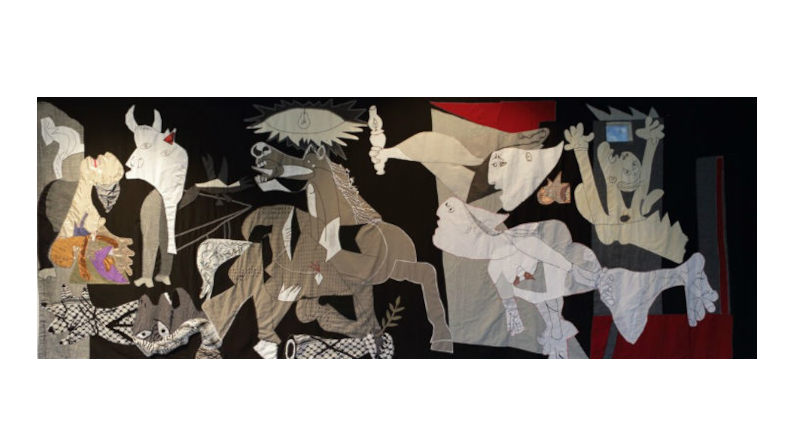
Remaking Picasso’s Guernica is a large collaborative protest banner created between 2012 and 2014 by a collective of twelve artists and activists.
On a protest march, a familiar image suddenly appears above the crowd.
A huge textile artwork stretches across the street, carried by several people walking side by side. Its fractured figures, screaming horse and shattered bodies are instantly recognisable. It is Picasso’s Guernica, but this version is not hanging in a museum. It is moving through the streets as part of a protest.
This work is called Remaking Picasso’s Guernica. Created between 2012 and 2014 by a collective of artists and activists, it transforms one of the most famous anti-war paintings in history into something new: protest art designed to move through public space.
Unlike Picasso’s original painting, the textile version was created through a collaborative public process.
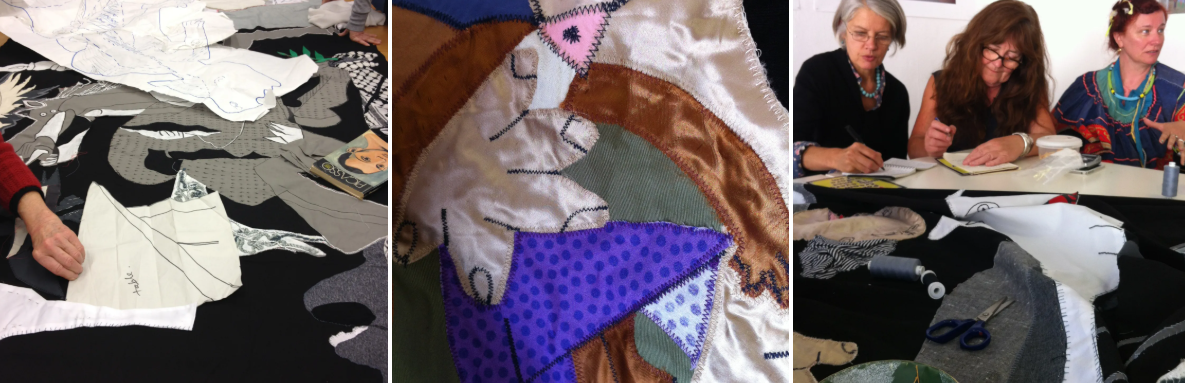
Fourteen open sewing sessions were organised in England and India, inviting anyone to take part. Participants stitched the shapes and figures that gradually formed the artwork.
“The individual shapes that form the banner have been sewn in place through a series of 14 public sewings held in England and India.”
People with little sewing experience sat beside experienced stitchers. Strangers worked together around tables scattered with fabric and thread. Slowly, piece by piece, the figures of Picasso’s composition emerged through many hands.
The finished work measures more than four metres across. Its scale means several people must carry it together during demonstrations, turning the act of display into a shared public statement.
The banner belongs to a long tradition of artists remaking Guernica, allowing Picasso’s protest against war to speak again in new places and new conflicts.
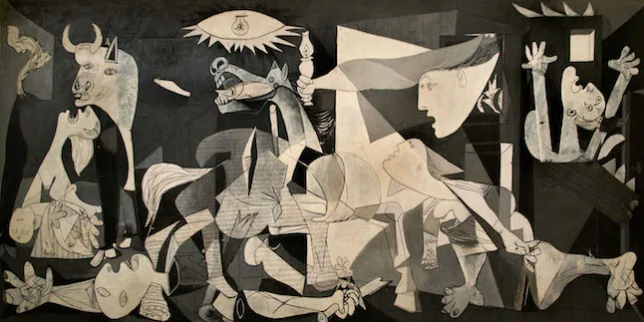
Picasso painted Guernica in 1937 in response to the bombing of the Basque town during the Spanish Civil War. The painting quickly became one of the most powerful artistic protests against the violence of modern warfare.
Picasso later refused to allow the painting to return to Spain while Franco’s dictatorship remained in power, reinforcing its reputation as a work of resistance.
The creators of Remaking Picasso’s Guernica wanted to bring that spirit into the present.
“The banner makes connections between historic and current government-led aerial attacks on civilian populations.”
The design echoes the original composition, including the bull, the wounded horse and the anguished human figures. But it also introduces new symbols that link the historic image to modern warfare.
Small stick figures appear across the body of the horse, representing civilians killed in contemporary aerial attacks, including drone strikes. They serve as a reminder that the victims of modern warfare are often reduced to numbers, their names and stories rarely known.
Picasso’s painting now hangs in the Museo Reina Sofía in Madrid. The textile reinterpretation was created for a very different setting.
It appears at demonstrations and public gatherings, including protests against the bombing of Gaza in 2014.
“The banner functions as both a work of art and an act of protest.”
Seen on a march, the image takes on a new life. It is no longer simply an artwork to be viewed quietly in a gallery, but a public statement carried through the streets.
More than eighty years after the bombing that inspired Picasso’s painting, the message still moves. Not on a canvas inside a museum, but in the hands of people who continue to challenge violence and demand peace.