Quaker trade token
The Quaker trade token represents how trust in early Quaker businesses was made tangible.
Richard and Mary Pearce's trade token
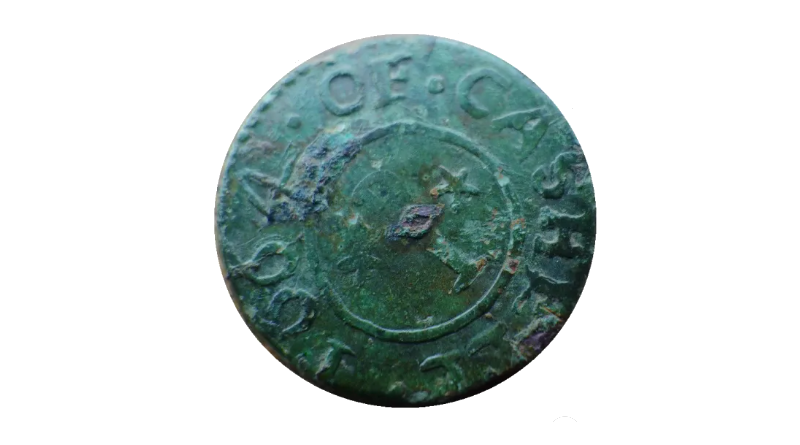
In 1668, the Quaker apothecary Richard Pearce and his wife, Mary, issued a trade token in Limerick, Ireland. Made from copper or brass, it carried a mortar and pestle, the traditional symbol of an apothecary, surrounded by the words “RICHARD . PEARCE . OF .”
On the reverse were the words “LIMERICK , APOTHECARY” and the initials R.M.P., representing Richard and Mary Pearce.
The token was issued at a time when there was a severe shortage of official small-denomination coins. Merchants responded by producing their own tokens, which could be used for small everyday transactions. Thousands were issued across Britain and Ireland during the seventeenth century.
Trust behind the token
A trade token was not official currency. Its usefulness depended instead upon confidence in the person or business that issued it. Someone accepting a Pearce token had to trust that it represented real value and would continue to be accepted or redeemed.
The name of the issuer therefore mattered. Richard Pearce did not simply put a monetary substitute into circulation. He put his own name and business behind it.
The mortar and pestle identified his trade, while the inscription identified the Limerick apothecary responsible for the token.
A reputation for fair dealing
That reliance on personal reputation had particular relevance for Quaker businesses. From the early years of the movement, Friends placed importance on honest dealing and straightforward transactions.
Within the Society of Friends, commercial behaviour was not considered separate from personal conduct, and dishonest dealings could damage a Friend's standing within the Quaker community.
This approach formed part of a wider Quaker business culture associated with Innocent Trades. Friends favoured forms of commerce they considered ethical, including fair and fixed prices.
Their close networks also allowed them to exchange goods, lend money and make business contacts with other Quakers. A reputation for reliability therefore had practical value as well as religious importance.
From token to reputation
Private trade tokens gradually disappeared after official copper coinage became more readily available and their use was restricted by the Crown. Quaker involvement in business, however, continued to grow.
In later generations, Friends established businesses in banking, manufacturing, retail and other trades, and some became widely associated with dependable dealing.
The Pearces' token belongs to a much earlier stage of that history. It was a practical response to a shortage of small change rather than a declaration of Quaker belief.
Yet its usefulness rested on something that would become important to the reputation of many Quaker businesses. It depended on confidence that the name stamped into a small piece of metal could be relied upon.