| | by admin | | posted on 29th March 2026 | Artworks | | views 22 | |
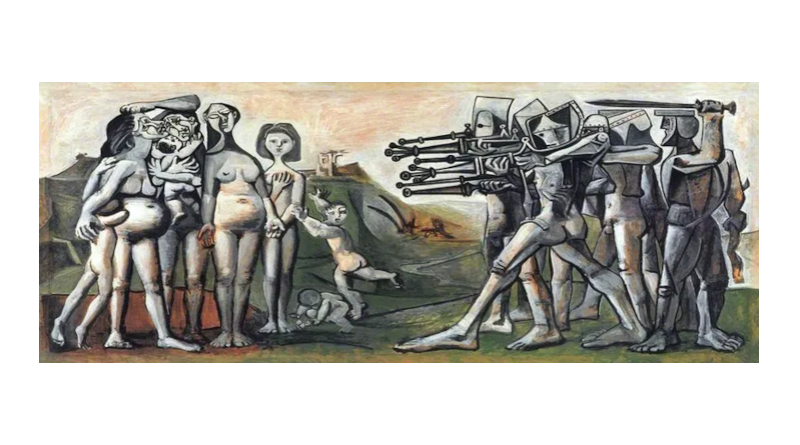
Massacre in Korea (1951) stages a confrontation between armed soldiers and exposed civilians, holding the moment just before violence is carried out.
A line of soldiers stands rigid on the left, their bodies mechanical, their faces obscured, rifles angled forward in a single direction. Opposite them, a group of women and children gathers on bare ground, their bodies exposed and unprotected, their forms varied and human. The space between the two groups is shallow, almost flattened, giving the scene the quality of a stage rather than a landscape. Painted in oil on plywood and measuring approximately 1.1 × 2.1 metres, the work is wide and compressed, forcing the figures into direct confrontation without distance or escape. The moment is held, not yet broken, but already determined.
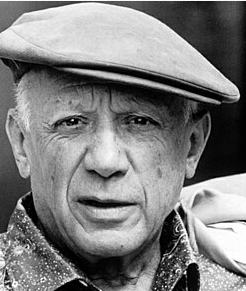
The painting was made by Pablo Picasso (1881 - 1973), the Spanish artist whose career spanned multiple movements and whose work repeatedly returned to war and its consequences. Already internationally recognised by 1951, he had earlier created Guernica, establishing a visual language through which violence could be exposed without being illustrated directly. Here, that language becomes more concentrated, reduced to a single encounter.
Painted during the early years of the Korean War, the work does not depict a specific documented event. Instead, it draws on reports and images of civilian killings that circulated at the time, transforming them into a scene that is both particular and general. The soldiers are not identifiable as a single army, and the civilians are not tied to a named location. The effect is deliberate. By removing specificity, the painting resists being contained within one incident.
The composition echoes earlier images of execution, most notably firing squads arranged in opposition to unarmed victims, but it strips away setting and narrative detail. There is no landscape to absorb the violence, no crowd, no aftermath. What remains is the structure of the act itself: those who hold weapons and those who do not. The scene is not shown as it unfolds but as it gathers, held in the instant before action becomes irreversible.
There is no widely documented, artwork-specific quote from Pablo Picasso directly about Massacre in Korea, which makes his broader statements about painting and war all the more important in understanding the work.
“Painting is not made to decorate apartments. It is an instrument of war.”
In this sense, the painting does not describe violence, it confronts it. The viewer is not positioned as an observer at a distance but is held within the same shallow space as the figures themselves. There is no escape into narrative or history, no framing device that allows the scene to be understood as safely past. Instead, the work functions as a form of witness, placing the reality of civilian vulnerability at the centre of the image.
Within peace culture, this shift is significant. The painting does not offer resolution, heroism, or justification. It removes the structures that often make war legible and leaves only its imbalance. As with Guernica, Picasso's concern is not with strategy or outcome, but with what violence does to those who cannot resist it.
Nothing has yet happened, and yet everything has already been decided. The rifles are raised, the figures are fixed, and the space between them cannot hold. The power of the painting lies in this suspension, in the moment that refuses to move forward but cannot be undone.
By stopping short of the act itself, Massacre in Korea makes the viewer remain inside it. The violence is not shown, but it is unavoidable.