Make your mark for peace
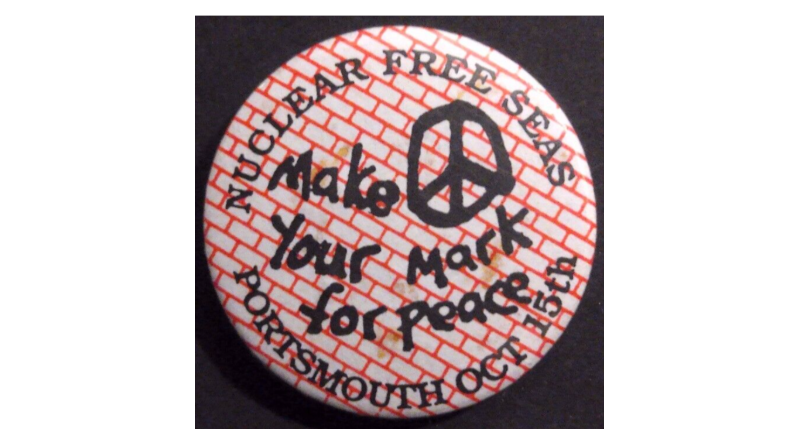
Make your mark for peace is a vintage pin badge marking the moment the Campaign for Nuclear Disarmament (CND) and Greenpeace united for nuclear-free seas.
Docking the bomb
By the late 1980s, the Cold War had quietly slipped below the waterline. While the world watched the arms race on land, global navies were routinely sailing undisclosed nuclear free-fall bombs and depth charges directly into civilian harbours.
Greenpeace launched the international Nuclear-Free Seas campaign to drag this hidden threat out of the depths. Defying the official military policy to "neither confirm nor deny" the presence of weapons, the campaign sought to expose exactly what was parked at the end of the local pier.
The shore and the sea
To challenge the fleets, Greenpeace dispatched protest ships to blockade the harbours. But to truly squeeze the military establishment, they needed boots on the ground. That was where the CND stepped in.
The badge points to a specific convergence on October 15th at the Royal Navy dockyards in Portsmouth. The port had become a major flashpoint, fuelled by the revelation that nuclear warheads were being secretly transported through local residential streets. Greenpeace held the water, while CND activists descended on the gates to hold the land.
The writing on the wall
The imagery on the pin is stark and instructional. A CND peace symbol and a rallying cry are drawn across a red brick pattern in thick, black lines, mimicking the hasty stroke of a marker pen or spray can.
Make your mark was not the name of a campaign, but a direct order for Non-Violent Direct Action (NVDA). Grassroots activists were told to bring paint and stencils to the protest. The double entendre was clear: physically tag the perimeter walls of the military base, and metaphorically leave your mark on history.
Permanent marker
Graffiti at a highly secure naval base is an inherently fleeting tactic. As soon as the crowds dispersed from Portsmouth, the authorities brought out the pressure washers and scrubbed the dockyard brickwork clean.
But the paint was never meant to last. What became permanent that day was the blueprint of two massive movements—maritime direct action and grassroots street protest—working in total unison. The physical graffiti washed into the harbour decades ago, but this badge survives to prove that a united resistance leaves an indelible mark.