
| | by admin | | posted on 13th April 2026 | Peace Camps | | views 5 | |
Lakenheath Peace Camp (2024 - ) is a recurring nonviolent protest encampment established outside RAF Lakenheath, where activists live, organise and resist the presence of nuclear weapons on British soil.
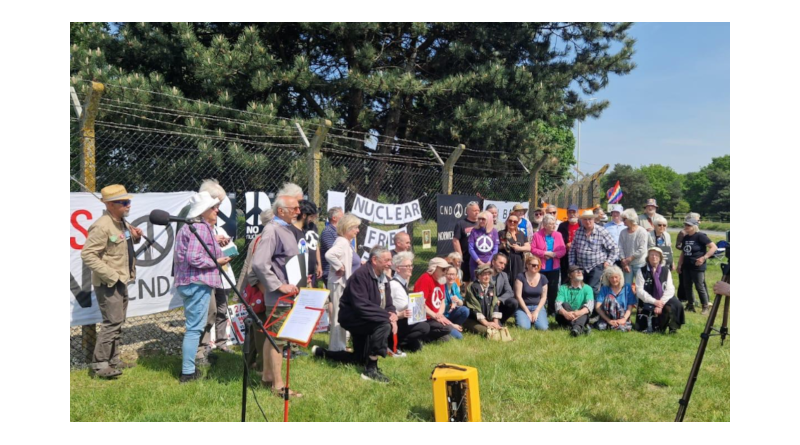
On the perimeter of RAF Lakenheath, a different kind of presence takes shape. Tents are pitched along the roadside. Banners are tied to fences. A kitchen is assembled, meetings are held, and a community begins to form. The peace camp is not a gathering that comes and goes in hours; it is sustained across days and weeks, creating a continuous act of protest at the edge of a military base.
This form matters. By remaining in place, the camp transforms protest into presence. It refuses distance. Where nuclear weapons policy is often discussed in abstract terms, the camp insists on a physical response, grounded in the same landscape where those decisions take effect.
The Lakenheath Peace Camp first took shape in 2024, alongside the formation of the Lakenheath Alliance for Peace. It emerged in response to renewed evidence that infrastructure for US nuclear weapons was being reintroduced to the base. From the beginning, the camp drew on a longer tradition of anti-nuclear organising in Britain, particularly the peace camps of the late 20th century.
That lineage is not symbolic alone. It is practical. The camp brings together activists, campaigners and local residents in a shared space, combining protest with cooperation. It is here that an alliance becomes visible: not only in statements or campaigns, but in the daily work of living, organising and acting together.
“Peace camps are places where people come together to resist war preparations through nonviolent means and collective presence.”
The structure of the camp is both simple and deliberate. At its centre is a continuous vigil at the base gates, maintained day and night. Around this, a temporary community develops. Shared kitchens, meeting spaces and welfare areas support those taking part, making it possible for the camp to endure over time.
Workshops and discussions run throughout the camp, exploring nuclear weapons, climate impacts and strategies of nonviolent resistance. In this way, the camp becomes a place of learning as well as protest. It does not only oppose; it also prepares, equipping participants with the knowledge and methods needed to sustain action beyond the camp itself.
Direct action forms the third strand. Blockades, road occupations and coordinated disruptions are organised from within the camp, bringing the protest into direct contact with the operations of the base. These actions have led to arrests, placing participants within a longer history of civil resistance.
By 2026, the Lakenheath Peace Camp had taken on a more defined and international character. Held over several days in April, it brought together hundreds of participants, including activists from outside the UK. The camp combined continuous vigil, political discussion and coordinated action, culminating in blockades that closed base entrances for hours at a time.
The focus of the camp had also widened. While opposition to nuclear weapons remained central, the protest increasingly addressed ongoing conflicts and the role of the base within them. A formal letter delivered during the camp challenged both UK and US authorities on questions of international law and accountability.
“The presence of nuclear weapons here places this community on the front line of global risk.”
The Lakenheath Peace Camp brings together three elements that are often kept apart: protest, community and education. It is at once a site of resistance, a place of shared living and a space for political formation. Each depends on the others. Without presence, protest fades; without community, it cannot endure; without understanding, it cannot deepen.
In returning to the form of the peace camp, the movement at Lakenheath draws on a familiar tradition while responding to a present reality. The nuclear age has not disappeared; it has shifted, adapted and reappeared in new forms. The camp answers this not with distance, but with proximity. It places people at the edge of the base and asks a simple question: what does it mean to live here, knowing what is prepared just beyond the fence?