
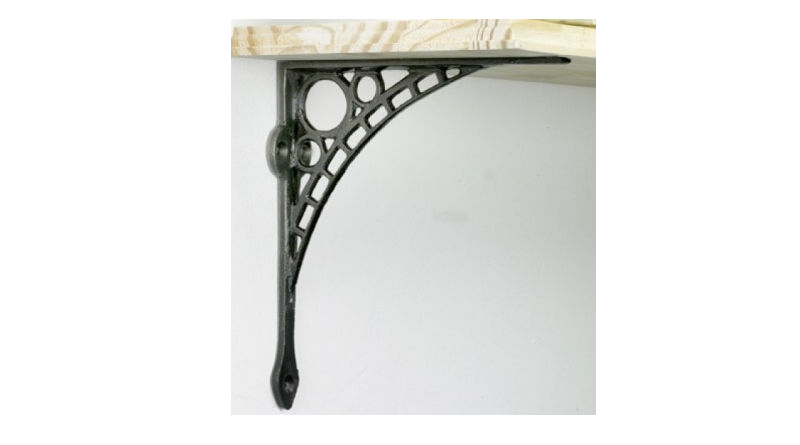
Iron Bridge shelf bracket
The Iron Bridge shelf bracket is inspired by the world's first ever bridge made by iron, which was built by a Quaker family.
The Darbys and the Industrial Revolution
The Quaker family, the Darbys, were based in Shropshire, England, and the Iron Bridge opened in 1781.
The Darbys' influence over the Industrial Revolution began decades earlier. In 1708, Abraham Darby I (1678–1717) came to Shropshire to repair an iron-making furnace at Coalbrookdale.
Darby I had begun his career as a brass maker. Upon repairing the furnace, he discovered that iron could be smelted with coke instead of charcoal.
Using coke in the smelting process was superior to charcoal because coke, a manufactured form of coal, was in plentiful supply. Smelting iron with coke freed the iron industry from the need to rely on trees, which charcoal came from. Coke also had fewer impurities than charcoal and became more cost-effective.
Darby I leased the 'coke' furnace he'd repaired and set up an accompanying foundry that soon began mass-producing kettles, pots and cauldrons.
Abraham Darby I died in 1717, when his son Abraham Darby II (1711–1763) was only six.
Darby II's mother, Mary, and fellow Quakers who established the Coalbrookdale Company, managed the foundry until his son was old enough to take over the business. Mary died only a few months later, but the newly established company kept iron production going through the disruption.
Like his father, Darby II was an innovator. He joined the company in 1728, and in 1742 he built a steam-powered engine that could recycle water.
By recycling its water supply, the foundry became more efficient. This allowed the company to grow, taking over several nearby furnaces and upgrading them with the new technology.
The Coalbrookdale Company also went on to influence the newly emerging railway industry. Until then, horses had pulled wooden carts on wooden rails to transport iron and raw materials.
From 1767, the company produced iron wheels and rails, which were far more durable and longer-lasting than wood. The use of iron over wood would dominate railway building, and by the time the first commercial steam locomotives appeared in the early 19th century, iron had become the material of choice for construction.
Building the bridge
By the time Abraham Darby III (1750–1789) joined the company in 1768, Coalbrookdale was a major employer that provided a school and cottages for its workers, as well as paying higher wages.
To keep up with increasing demand, the company needed a bridge to cross the River Severn. The company issued shares to raise the £3,200 required, with Darby III agreeing to pay for any overspend himself.
Engineers had estimated the bridge would need 300 tons of iron, but the build eventually used 379. This, along with other cost overruns, pushed the total nearly £3,000 over the original estimate, nearly doubling the cost and leaving Darby III in debt for the rest of his life.

The Iron Bridge opened in 1781 and by the mid-1790s it was highly profitable, with tolls giving shareholders an annual dividend of eight per cent.
More than 150 years later, in 1934, the bridge was designated a Scheduled Ancient Monument and closed to vehicular traffic. Tolls for pedestrians were collected until 1950. The bridge, the adjacent settlement of Ironbridge and the Ironbridge Gorge now form the UNESCO Ironbridge Gorge World Heritage Site.
The Iron Bridge shelf bracket is available to buy from Black Country Metal Works (opens in a new tab).