
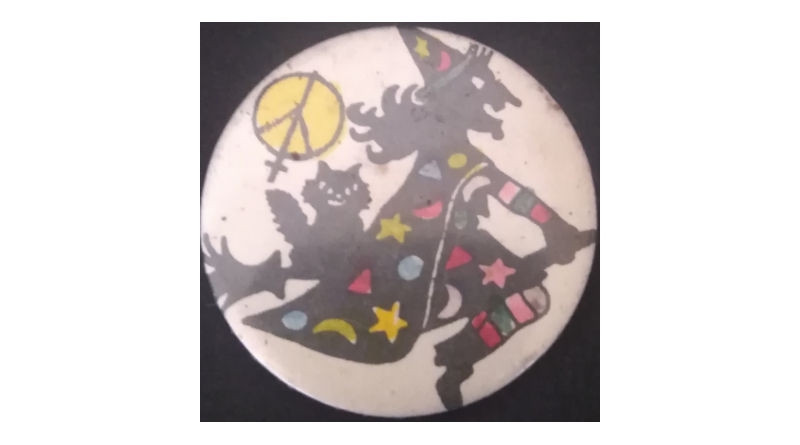
Greenham Witch
Greenham Witch is a handmade vintage pin badge that celebrates how several protesters at Greenham Common turned themselves into 'witches'.
Outside the bounds of 'acceptable behaviour'
The perimeter fence at RAF Greenham Common drew a hard line through the Berkshire countryside. On one side stood the concrete silos built to house American nuclear cruise missiles.
On the other was the mud, the woodsmoke and the women of the Greenham Common Women's Peace Camp. Established in 1981, the camp began as a march and settled into a permanent occupation.
The women who lived outside the wire left behind the expectations of polite society. By choosing to live in the cold to block the machinery of the Cold War, they stepped outside the bounds of 'acceptable behaviour'.
The witch as a newspaper headline
The badge depicts a traditional witch flying on her broomstick, accompanied by a black cat. Her cloak is covered in brightly coloured stars, crescents and geometric shapes. Above her, a yellow moon incorporates the CND peace symbol and the female symbol, bringing together nuclear disarmament and women's liberation.
Adopting the figure of the witch was a deliberate choice for the women of the camp. The British media and authorities, struggling to understand their steadfast protest against nuclear cruise missiles, resorted to derogatory labels. Protesters were dismissed as dirty, unnatural and eccentric. The insult that stuck was 'witch'.
Instead of rejecting the label, the women of Greenham embraced it, reclaiming a figure historically persecuted for her independence and closeness to the earth, and turning her into a symbol for their own struggle.
Magic and feminist solidarity
For the feminist movement of the early 1980s, the witch was a figure of political resistance, an archetype already used elsewhere to protest corporate and state power. At Greenham, though, 'magic' was rarely just a metaphor.
Many of the women practised Goddess spirituality, weaving pagan ritual and fireside ceremony into the daily grind of camping in the woods. Reverence for the earth wasn't a slogan. It was lived, in circles held after dark, set against the sterile concrete of the base and the threat it held.
Spiritual symbolism also accompanied direct confrontation. On New Year's Day 1982, a group of women climbed the fence and danced on top of the missile silos, still under construction. The photographs of unarmed women standing on the machinery of nuclear war became one of the camp's most enduring images.
The bolt cutters under the cloak
This wasn't just theatre. It was cover for direct action. On the night of 31 October 1983, hundreds of women arrived at the gates dressed in full witch costume, announcing a Halloween party.
Expecting nothing more than singing and fancy dress, the guards lowered their watch. Under the cloaks were bolt cutters, bought quietly from hardware shops across the region.
Working fast, the 'witches' cut down roughly four of the base's nine miles of perimeter fence before the guards understood what the party really was.
It was one of the largest acts of anti-nuclear sabotage in British history, hidden behind an insult that men in newsrooms and government offices had thrown at them.
The witch beyond Halloween
The 1983 breach was not repeated. The military reinforced the perimeter with heavy fencing and razor wire, and large-scale cutting became impossible. So the women changed tactics.
They turned to sound and symbol instead. They performed 'keening', dressing in black and wailing loudly, mourning in advance the generations a nuclear war would kill.
They also wove webs of yarn and wool across the gates, a symbol they took directly from the spider. Fragile alone, strong once tied together. This was how the women saw themselves too.
The witch kept coming back. Magic. Protest. Feminism. Three names for the same thing — all cast together at a fence in Berkshire for a spell of dissent.