
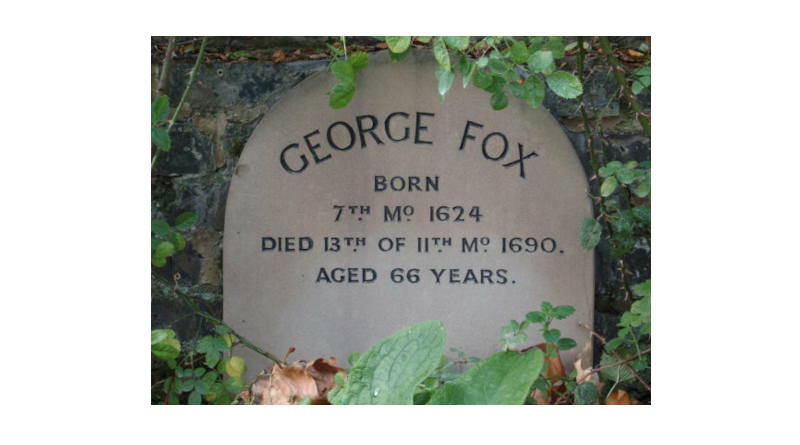
Gravestone of George Fox
The Gravestone of George Fox is an example of the simplicity behind a Quaker burial.
Quaker burials
For early Quakers, the burial ground was often the first piece of land acquired by a Quaker Meeting, and it commonly pre-dates the Meeting House built beside it.
From the mid-17th century, Quakers were either denied the right to bury their dead in parish graveyards, or chose not to do so.
At first they carried out burials in gardens and orchards, but they soon began to acquire their own burial grounds — following guidance from Fox. He urged Friends to, “Buy decent burying-places” and to, “Let them be decently and well fenced.”
Today, Friends are free to choose burial or cremation and may also opt for a non-Quaker funeral.
Bunhill burial grounds
Fox is buried in the Quaker burial ground beside Bunhill Meeting House in Islington, north London. Nearby lies Bunhill Cemetery, which became a popular burial place for Nonconformists denied interment by the Church of England.
Among those buried or commemorated at Bunhill Cemetery are these non-Quakers:
- William Blake (1757–1827), poet, printer and painter best known for the poem that later became the hymn Jerusalem.
- Daniel Defoe (1660–1731), novelist best known for Robinson Crusoe and Moll Flanders.
- John Bunyan (1628–1688), soldier turned preacher and author of The Pilgrim's Progress.
- Susanna Wesley (1669–1742), mother of John Wesley, founder of the Methodist Church.
Even Fox's grave carries no grand stone. Early Friends left it unmarked, as was their custom, and when a small marker did appear, it was pulled down around 1750 for drawing too much attention.
What stands there today is modest, plain enough that the founder of the Quakers rests, in the end, exactly as any other Friend would.