Girl with Balloon
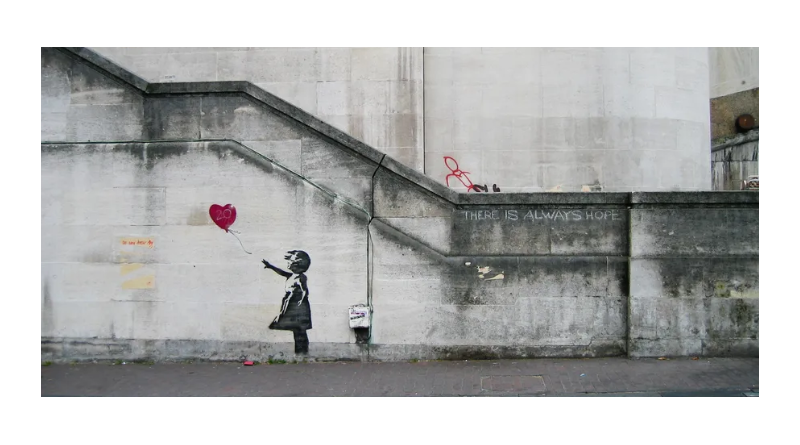
Girl with Balloon (2002) fixes the moment a balloon slips from a child's grasp, leaving it unclear whether it is being lost or released.
A moment reduced to a silhouette
A small girl, rendered in black stencil, leans forward with one arm outstretched. Her hair and dress are caught in a suggestion of wind, angled in the same direction as the object she reaches for. Just beyond her hand, a heart-shaped balloon drifts away, its thin string trailing behind it. The figure is rendered slightly smaller than life-size, reinforcing the sense of something fleeting rather than fixed.
The space around them is empty, a bare wall without depth or setting, reducing the image to a simple exchange between figure and object. Executed as graffiti using spray paint and stencil on an urban surface, and later reproduced in prints and canvas versions, the work depends on its economy. There is almost nothing here, and yet the moment is held with precision.
The image was created by Banksy, an anonymous British street artist known for placing politically charged works directly into public space. His practice draws on the language of graffiti and street art, using public walls as both canvas and context, allowing images to appear unannounced and circulate beyond traditional art settings.
From street image to global symbol
First appearing in early 2000s London, the image was painted on a wall beneath Waterloo Bridge, near the South Bank. As a piece of street art, it existed in a specific urban setting, encountered in passing rather than within a gallery. Its original context was local and temporary, tied to a particular wall and moment, but this did not remain fixed. Through reproduction, removal, and re-creation, the image detached from its initial setting and began to circulate more widely, appearing in prints, exhibitions, and public campaigns.
This shift reached a turning point in 2018, when a framed version of the image partially self-destructed at auction, becoming the work later titled Love is in the Bin. What had once been a temporary street image entered the structures of the art market, even as it appeared to resist them. The movement from wall to object did not stabilise the image so much as extend its reach, allowing it to operate across different contexts without settling into a single meaning.
A symbol without fixed meaning
The simplicity of the image has allowed it to move easily into different forms of public use. It has appeared in campaigns connected to displacement, conflict, and humanitarian crisis, where its open structure makes it adaptable without losing clarity. The balloon can be read in different ways — as hope, as love, as innocence, or as something already lost. The image does not insist on one interpretation, and its power lies in that openness.
“Art should comfort the disturbed and disturb the comfortable.”
This balance between tenderness and unease is central to how the work functions. It offers a moment that is easily recognised, but not easily resolved. The viewer is not told what has happened, only shown a gesture that could belong to loss or release. In this way, the image operates less as a statement than as a space in which meaning is made.
Letting go or losing hold
The child's gesture remains undecided. The balloon may be drifting away beyond recovery, or it may have been released deliberately into the air. Nothing in the image confirms one reading over the other. The moment is held just long enough to prevent resolution.
By refusing to settle the question, Girl with Balloon leaves its meaning suspended. What is being seen depends on how the moment is understood, and that understanding is never fixed.