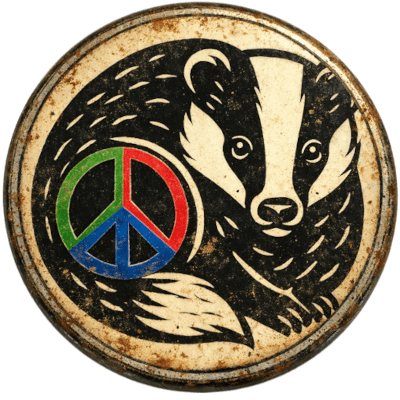

Gerald Holtom: Creator of the peace symbol
Gerald Holtom's iconic peace symbol, created for the Campaign for Nuclear Disarmament in 1958, became a global emblem for non-violent protest and anti-war movements.
The birth of a symbol
In 1958, British artist and designer Gerald Holtom created what would become one of the most enduring icons of the 20th century: the peace symbol. Commissioned for the Campaign for Nuclear Disarmament (CND), the symbol was first unveiled during a protest march from London to the Atomic Weapons Research Establishment at Aldermaston. The event marked Britain's growing grassroots resistance to nuclear weapons during the Cold War.
Holtom, a conscientious objector during World War II, based the design on the semaphore signals for the letters 'N' and 'D', standing for 'Nuclear Disarmament'. In semaphore, the letter 'N' is represented by two flags angled downward at 45 degrees, and 'D' by one straight up and one straight down. Overlaying the two created the now-familiar shape. He enclosed the symbol in a circle to complete the image. Though he initially considered adding a Christian cross, he ultimately chose a more universal message, one he described as a man in despair with arms outstretched downward.
Adoption by the Campaign for Nuclear Disarmament (CND)
The peace symbol became the official logo of CND and was quickly embraced by protestors across the UK. Its simplicity and emotional resonance gave it power beyond words, and it appeared on banners, buttons and leaflets throughout Britain's anti-nuclear movement. The Aldermaston Marches of the late 1950s and early 1960s strengthened the symbol's connection to civil resistance, as thousands of demonstrators, many of them young people, marched under its emblem.
The symbol's association with nonviolence was central to its identity. CND, while politically active, was firmly rooted in peaceful protest. Holtom's design carried this message clearly: a call not just for disarmament but for peace as a lived principle. Though the symbol was created for a specific campaign, its visual power and emotional clarity helped it transcend its original context.
From Britain to the world
During the 1960s, the peace symbol made its way across the Atlantic, becoming a prominent icon in the United States' civil rights and anti-Vietnam War movements. American activists adopted the emblem, often unaware of its British origins, as a broader cry against violence, injustice and war. It began to appear in marches, sit-ins and rallies, etched onto clothing, badges and placards.
What began as a call against nuclear armament became a universal sign of resistance to all forms of violence. It was used in protests against apartheid in South Africa, for women's rights and in environmental campaigns. Its association with pacifism and solidarity gave it a flexibility that allowed diverse movements to claim it as their own.
A lasting legacy
Gerald Holtom died in 1985, but his contribution to visual activism endures. While he once expressed regret that his design was born of personal despair, it came to symbolise hope for millions around the world. The peace symbol remains instantly recognisable and continues to appear wherever people gather to speak out for justice and nonviolence.
Today, the peace symbol is more than a historical artefact. It is a living emblem of resistance and compassion. Whether painted on a wall, pinned to a lapel or carried in a march, it quietly yet powerfully affirms a shared human longing: to live without fear and in peace with one another.