| | by admin | | posted on 11th August 2023 | Artworks | | views 1661 | |
Freedom Sculpture is a public monument by Cecil Balmond reflecting on the Cyrus Cylinder, exploring early ideas of human rights and cultural coexistence.
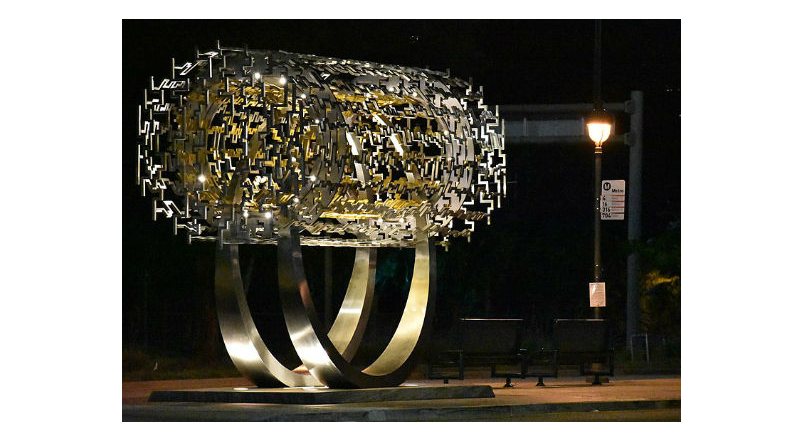
A public artwork by Cecil Balmond, unveiled on 4 July 2017 in Century City, Los Angeles, Freedom Sculpture is constructed from stainless steel in gold and silver tones. It stands on the median of Santa Monica Boulevard, encountered in motion rather than at rest.
Drawing on one of the earliest known expressions of human rights, the sculpture carries an ancient idea into the present.
The work takes its inspiration from the Cyrus Cylinder, a sixth century BCE clay object often described as an early statement of human rights. Inscribed with a message of tolerance and governance, it has come to symbolise principles that extend far beyond its original context.
Rather than replicating the object, Balmond translates its significance into a contemporary form. The sculpture becomes a continuation rather than a reproduction — an idea carried forward across time.
The structure consists of two interlocking cylindrical forms, one silver, the other gold. The outer shell appears open and flowing, while the inner core is more contained. Together, they suggest both protection and revelation.
Designed to be seen from passing vehicles, the work shifts as it is viewed. Lines slide across one another, surfaces catch and release light, and the form resists a single fixed image. By day, the metal reflects the brightness of the Californian sun; by night, the inner cylinder emits a soft glow.
Commissioned by the Farhang Foundation, the sculpture was supported by a wide network of contributors, giving it a collective rather than singular origin.
In this sense, the work reflects the idea it represents. Freedom is not presented as something imposed, but as something sustained through participation.
Placed within the flow of everyday life, Freedom Sculpture does not ask to be studied for long. It appears briefly, then disappears, returning again from a different angle.
In that repetition, its meaning accumulates. An ancient idea passes through a modern city, not as a fixed statement, but as something continually renewed.