Firemen against nuclear weapons
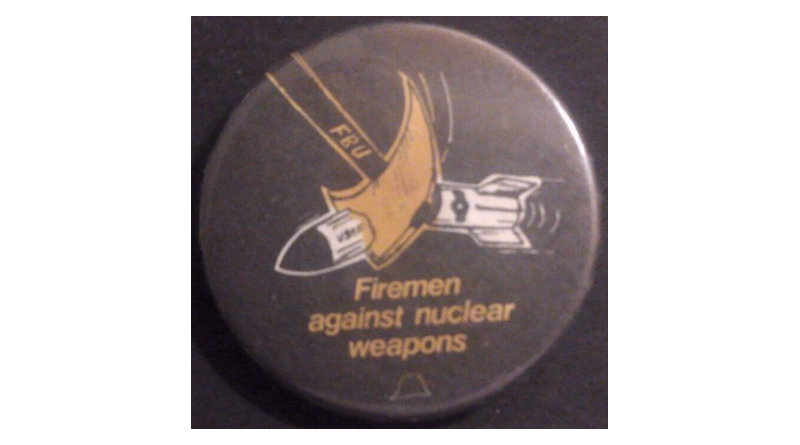
Firemen against nuclear weapons is a vintage pin badge marking the Fire Brigades Union's blunt message to the British government that nuclear war was not a fire they could put out.
Doors propped against the wall
During the 1980s, the British government developed extensive civil defence plans to prepare the public for a potential Cold War strike. The plans assumed local emergency services would be first on the scene after a nuclear strike, left to manage the fallout and put out the fires.
The government issued public advice, such as the Protect and Survive booklet, which suggested civilians could survive a nuclear blast by whitewashing their windows or hiding under doors propped against walls. To the emergency workers tasked with pulling bodies from ordinary house fires, these instructions were a grim absurdity.
Under General Secretary Ken Cameron, the FBU firmly rejected the role of first responder in a nuclear war, calling government plans a dangerous sham designed to make nuclear war appear manageable. It refused to take part in civil defence exercises, saying standard equipment offered no protection against a thermonuclear blast.
A uniformed voice against the bomb
The union did not limit its resistance to committee rooms. The FBU was nationally affiliated to the Campaign for Nuclear Disarmament, putting a uniformed emergency service on record against the bomb.
Union members regularly took to the streets to demonstrate their resolve. Their banners were a familiar sight at CND's mass demonstrations through the 1980s, and firefighters were very likely among the hundreds of thousands who filled Hyde Park for CND's October 1983 rally.
Beyond the marches, the union's solidarity reached further still. Like many trade union branches through the 1980s, FBU members sent banners, donations, and support to the women camped at Greenham Common, part of a wider labour movement standing behind the peace camps.
The Chernobyl effect
In 1986, an explosion at the Chernobyl nuclear plant bore out the union's warnings, at a terrible cost. The first Soviet firefighters on the scene died agonising deaths from radiation sickness. No fire crew, it turned out, could stand against a nuclear catastrophe and win.
Ken Cameron took this grief directly to the 1986 Trades Union Congress in Brighton. He made sure the British labour movement did not look away from the deaths of his Soviet counterparts, moving an anti-nuclear resolution that honoured the fallen firefighters and demanded an end to nuclear weapons.
The axe and the missile
The image on the badge is a wish, not a plan. No fireman's axe has ever chopped a nuclear missile in half, and the union knew it best. Their canvas hoses and breathing apparatus were built for house fires and factory blazes — not for what Chernobyl had already shown.
Firemen against nuclear weapons doesn't pretend the axe would work. It just insists someone should have swung it sooner.