Firemen against nuclear weapons
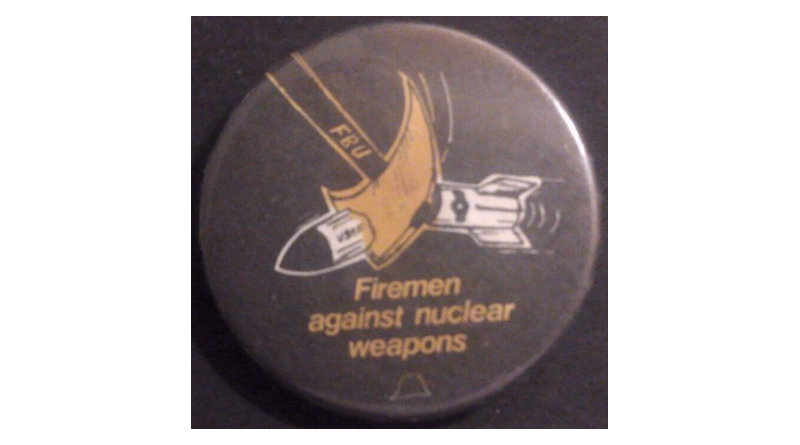
Firemen against nuclear weapons is a vintage pin badge that marks the moment when the British Fire Brigade Union refused to normalise the threat of a Cold War nuclear strike.
The axe and the missile
The badge uses a dark, muted background to highlight a sharp, active image. A large fireman's axe, drawn in bright gold and black, swings downwards, guided by curved motion lines that suggest heavy force. The broad blade strikes directly through the centre of a black and white nuclear missile, cleanly chopping the weapon in two.
The letters FBU are printed along the handle, identifying the Fire Brigades Union. Below the severed rocket, the phrase Firemen against nuclear weapons is printed in gold, resting just above the faint outline of a traditional fire bell.
Refusing the civil defence sham
During the 1980s, the British government developed extensive civil defence plans to prepare the public for a potential Cold War strike. These official strategies relied heavily on the assumption that local emergency services would act as first responders in a post-nuclear landscape, managing the fallout and extinguishing the fires.
The government issued public advice, such as the Protect and Survive programme, which suggested civilians could survive a nuclear blast by whitewashing their windows or hiding under doors propped against walls. To the emergency workers tasked with pulling bodies from ordinary house fires, these instructions were a grim absurdity.
Under the leadership of General Secretary Ken Cameron, the FBU firmly rejected this assignment. The union argued that government plans were a dangerous sham designed to make nuclear war appear manageable. They refused to participate in official war games, stating clearly that standard emergency equipment could offer no protection against a thermonuclear blast.
Firemen on the march
The union did not limit its resistance to committee rooms; it brought its tangible presence to the peace movement. The FBU formally allied with the Campaign for Nuclear Disarmament, bringing the sturdy, trusted weight of organised emergency workers directly into the public resistance.
Union members regularly took to the streets to demonstrate their resolve. During the massive October 1983 CND rally in Hyde Park, which drew hundreds of thousands of people, firefighters marched in full uniform alongside their official union banners. This visual tactic proved that opposition to the bomb was not a fringe belief, but a practical concern for frontline workers.
Beyond the marches, local FBU branches provided grounded support to direct-action sites. They delivered financial aid, essential supplies, and solidarity delegations to the women living in the damp weather at the Greenham Common Women's Peace Camp, ensuring the peace camps had the resources to endure.
The 1986 Chernobyl disaster
The union's stark warnings were tragically validated by the 1986 Chernobyl disaster. The agonising deaths of the first-responding Soviet firefighters from acute radiation sickness provided concrete proof that emergency services could not mitigate a nuclear catastrophe.
Ken Cameron took this grief directly to the 1986 Trades Union Congress in Brighton, ensuring the deaths of his Soviet counterparts were not ignored by the British labour movement. Moving a high-profile anti-nuclear resolution, he used his time on the conference floor to honour the fallen workers and demand an end to nuclear weaponry, turning international tragedy into resolute union policy.
The artwork pressed into the badge reflects this harsh, material reality. A standard canvas hose or a compressed air breathing apparatus offers no defence against a radioactive firestorm. By showing a standard piece of firefighting equipment destroying the missile itself, the tin leaves no doubt as to the union's steadfast position.
Firemen against nuclear weapons serves as a lasting reminder that the only practical way for a firefighter to survive a nuclear fire is to take an axe to the nuclear missile before it is ever launched.