| | by admin | | posted on 6th April 2026 | Artworks | | views 11 | |
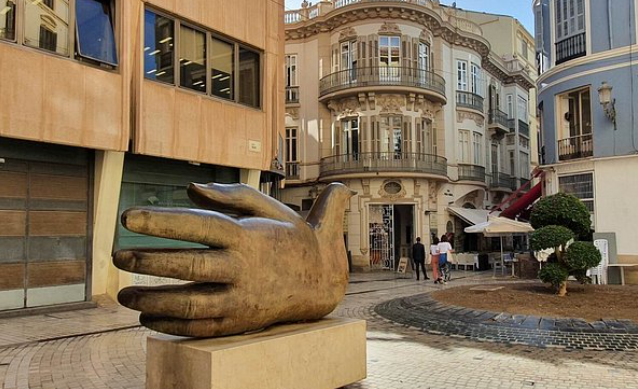
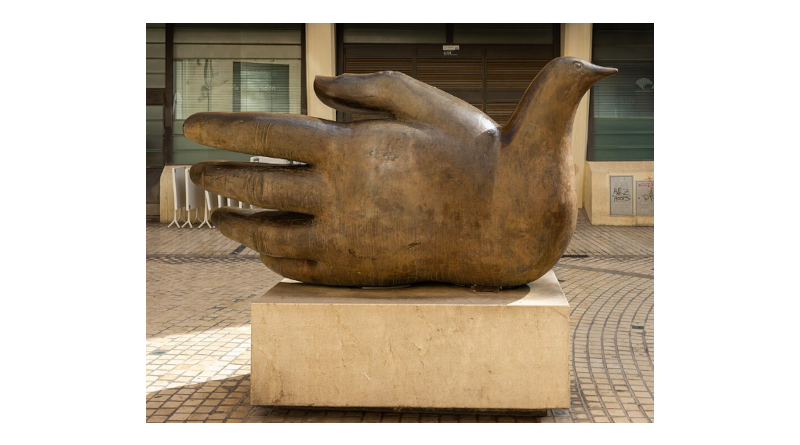
Escultura Ave Quiromántica (2001) binds hand and dove into a single form, where peace is both held and let go.
A smooth bronze form rises from a pale marble pedestal, its surface flowing without a sharp division between finger and wing. From one angle, the sculpture reads as an open human hand, palm lifted slightly upward in a gesture of offering. From another, the same form resolves into a dove, its body emerging from the curve of the fingers as if about to take flight. The transition is continuous. The hand does not simply release the bird, but seems to become it. Installed at a modest urban scale in the historic centre of Málaga, the work is cast in bronze and set on stone, its material weight balanced by the lightness of the form it suggests.
The sculpture was created by the Málaga-born artist José Seguiri, based on a drawing by the poet and artist Rafael Pérez Estrada. Seguiri keeps the treatment deliberately restrained, allowing the clarity of the form to carry the idea without ornament. What we are looking at is neither a hand holding a bird nor a bird leaving a hand, but a single object suspended between the two.
The title introduces a further layer. ‘Quiromántica’ refers to chiromancy, the reading of the palm as a map of fate. In this context, the hand is not only a physical form but a site of interpretation, a place where meaning is sought and futures imagined. By shaping the dove directly from the hand, the sculpture suggests that what we read as destiny may in fact be something we enact. Peace does not arrive from elsewhere. It emerges from human gesture.
Installed in 2001 along Calle Bolsa, a street of constant movement in central Málaga, the work sits within the flow of everyday life. It is encountered in passing rather than approached as a destination. That context matters. The sculpture does not isolate peace as a distant ideal, but places it within the ordinary rhythms of a city, where hands meet, exchange and act. Its changing appearance from different viewpoints reinforces that instability. Peace is not fixed, but depends on how it is seen and how it is made.
Within peace culture, the dove is one of the most widely recognised symbols, often detached from the actions that might sustain it. Here, that separation is closed. The bird cannot exist independently of the hand that forms it. In this way, the sculpture resists the idea of peace as something purely symbolic or decorative. It insists instead on a connection between image and responsibility.
Seguiri's translation of Pérez Estrada's drawing into bronze carries a quieter significance too. A line on paper becomes a solid object in public space, moving from private imagination into shared environment. The work does not demand attention through scale or drama, but through recognition. It offers a form that can be understood almost immediately, yet continues to unfold as the viewer shifts position, physically and conceptually.
There is no clear moment of release in the sculpture. The dove is neither fully contained nor fully free. Instead, it exists in a state of suspension, held within the hand even as it suggests departure. This ambiguity gives the work its force. Peace is not shown as an achieved condition, nor as something entirely beyond reach, but as something held in tension between intention and action.
In that sense, the sculpture does not resolve its own image. It leaves the gesture incomplete, asking what it would mean to carry it forward. The hand remains open, the bird still forming, and the outcome is left to the space beyond the bronze.