
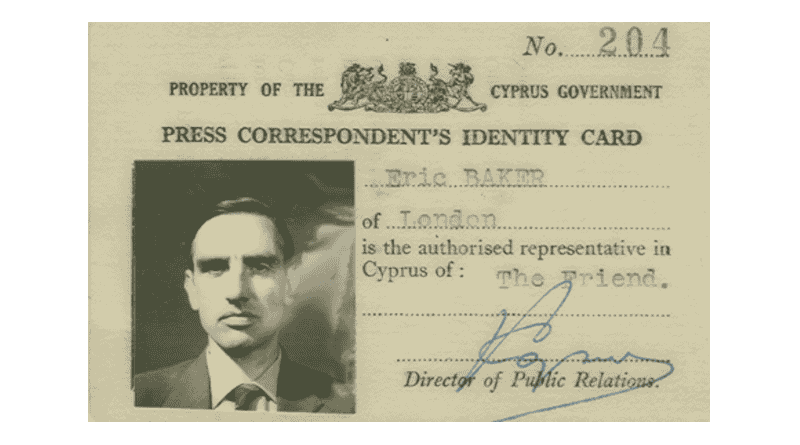
Eric Bakker's press pass
em>Eric Baker's press pass belonged to a Quaker who helped found CND and Amnesty International, two of many organisations with Quaker roots.
A correspondent in Cyprus
Eric Baker's photograph appears on a Cyprus Government press card, numbered 204. The card identifies him as a correspondent for The Friend, the British Quaker journal.
In June 1958, the Friends Peace Committee sent Baker to the island to discover whether Quakers could help amid mounting violence. Cyprus was still under British rule, with Greek Cypriot nationalists seeking union with Greece and Turkish Cypriot groups opposing that outcome.
Press accreditation helped Baker travel around the island, where curfews and security checks made movement difficult. Writing from Nicosia, he remarked, “If I was looking for trouble, here it is.”
Baker spoke with government officials, prison authorities, diplomats and refugees. He found little prospect of immediate Quaker intervention and advised Friends to remain in contact in case an opportunity arose.
Baker's beginnings
Baker became a Quaker while still at school. During the Second World War, he registered as a conscientious objector, refusing military service.
In 1946, Baker and his wife Joyce became joint secretaries of the Quaker Centre in Delhi, India. Their work took them into a country approaching independence from British rule, where political and religious divisions were creating growing tensions.
After returning to Britain, Baker became general secretary of the National Peace Council, which brought together organisations working for peace and disarmament.
In 1958, he helped establish the Campaign for Nuclear Disarmament (CND), which opposed Britain's possession of nuclear weapons. Baker also made office space available to the new movement, providing a practical base for its early work.
The roots of Amnesty International
Baker's investigations concerning Cyprus brought him into contact with Peter Benenson, a British lawyer investigating the treatment of political prisoners. The two continued working together after Baker's visit.
In 1961, Benenson launched an appeal for people imprisoned because of their beliefs. Baker helped organise the campaign that developed into Amnesty International, which sought the release of prisoners of conscience.
Baker's wife Joyce later summed up their different contributions: “Peter was the inspiration, Eric was the engineer.”
Baker remained closely involved with Amnesty International, chairing its British section from 1965 to 1971 and helping develop its campaign against torture. He died in 1976. The following year, Amnesty International received the Nobel Peace Prize.
Other organisations with Quaker founders
In 1839, Quaker abolitionist Joseph Sturge helped found the British and Foreign Anti-Slavery Society, one of numerous organisations with Quaker founders still active today. Now called Anti-Slavery International, the organisation campaigns against modern slavery, including forced labour and human trafficking.
A century later, Quaker Edith Pye helped organise famine relief efforts that contributed to the creation of the Oxford Committee for Famine Relief in 1942. The committee later became Oxfam.
In Canada, Quakers Dorothy and Irving Stowe helped establish the Don't Make a Wave Committee in 1969 to oppose American nuclear testing in Alaska. The group organised a protest voyage in 1971 that helped launch the movement subsequently known as Greenpeace.
Three years later, British Quakers joined other peace organisations to establish the Campaign Against Arms Trade, challenging the international sale of weapons.
In 2018, Quaker Ian Bray helped found Extinction Rebellion, which uses nonviolent civil disobedience to call for action on climate change and ecological destruction.
Baker's later years
Baker continued his work with Amnesty International, becoming increasingly concerned about the torture and mistreatment of prisoners. In 1973, he helped organise an international conference against torture in Paris and continued raising the issue among British Quakers.
Eric Baker died in 1976. The following year, Amnesty International received the Nobel Peace Prize, recognising an international human rights movement he had helped establish just 16 years earlier.