| | by admin | | posted on 10th April 2026 | Artworks | | views 10 | |
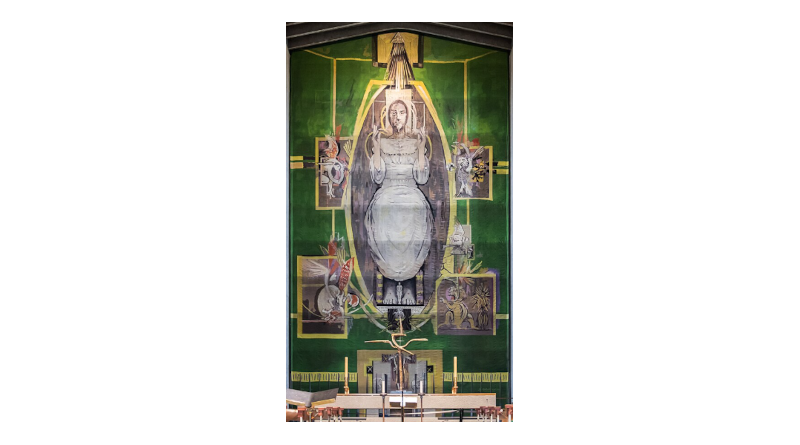
Christ in Glory in the Tetramorph (1962) presents the figure of Jesus Christ as a monumental presence, where identity is clear but held in a form that resists individual likeness.
A vast tapestry fills the east end of the cathedral, rising high above the altar in a single continuous field of woven colour. At its centre sits a monumental figure, frontal and unmoving, occupying the space with a calm authority that resists any sense of motion. The figure is Jesus Christ, identified through the traditional composition of Christ in Glory and the surrounding tetramorph - the man, the lion, the ox and the eagle - yet it is not rendered as an individual likeness. Facial detail is reduced, expression is held back, and the form is defined through scale and presence rather than personality.
Measuring approximately 23 by 12 metres and woven in wool, the surface absorbs light rather than reflecting it, giving the image a depth that feels both physical and distant at once. The tapestry was designed by the British artist Graham Sutherland and installed in 1962 as part of the newly built Coventry Cathedral. Known for combining abstraction with recognisable form, Sutherland creates an image that is neither purely symbolic nor fully descriptive. What we are looking at is a figure that is both specific and removed, identifiable yet held at a distance.
The tapestry cannot be separated from the building that holds it. The new cathedral stands beside the ruins of the original medieval structure, destroyed during the bombing of Coventry in November 1940. Those roofless walls remain open to the sky, preserved not as a relic but as a statement. The new building does not replace the old so much as stand alongside it, holding destruction and rebuilding within the same site.
Installed at the point where the rebuilt space gathers its focus, the tapestry becomes part of this response. It does not depict the violence that led to its creation, nor does it attempt to resolve it. Instead, it establishes a centre within a place marked by fragmentation. The figure remains still, while the history around it is anything but.
The image offers no direct answer to destruction. There is no narrative of conflict, no visible trace of the events that shaped the space. Instead, the work holds a form of order that does not depend on forgetting what came before. The figure does not intervene or act, but remains, establishing a point around which the space can be understood.
In this way, the tapestry operates as part of a wider act of reconciliation. It does not remove the presence of the ruins, nor does it attempt to overwrite them. It exists alongside them, allowing both destruction and renewal to remain visible. The balance it creates is not one of resolution, but of coexistence.
Nothing in the image moves, yet the space around it continues to carry the weight of what has happened there. The figure does not change, and the order it suggests does not shift. It remains fixed, not as a conclusion, but as a point of orientation.
In that stillness, something holds. The tapestry does not erase destruction, nor does it resolve it. Instead, it refuses to let it be the final condition of the space. The figure remains at the centre, and what surrounds it is gathered rather than undone.