
Campaign for Nuclear Disarmament
The Campaign for Nuclear Disarmament is a British anti-nuclear movement founded in 1958 to press for the unilateral abolition of Britain's nuclear weapons. It became known for the Aldermaston Marches and the Greenham Common Women's Peace Camp, and drew an estimated 300,000 people to its 1983 rally against cruise missiles. It continues to campaign today against Britain's Trident nuclear weapons system.
Sections
Badges
Showing 231 to 233 of 233 total badges
In numbers
£205 Billion
Minimum estimated cost to replace the UK's current Trident nuclear weapons system.
0
State funding accepted from nuclear-armed nations, maintaining strict financial independence.
460,000
Peak national membership reached during the height of anti-cruise missile campaigns.
450
Individual regional chapters formed rapidly across towns and universities during initial groundswells.
150,000
Peak estimated single-day attendance recorded at the historic Easter Aldermaston marches.
52
Miles walked along the historic route from Aldermaston to Trafalgar Square.
350
Activists detained during direct actions blocking the submarine base at Holy Loch.
4
Operational Royal Navy Vanguard-class submarines carrying the nuclear deterrent targeted for decommissioning.
557
Physical boxes of preserved historical records charting decades of the peace movement.
Timeline
-
1957, NovemberCND's founding committee forms
Responding to J. B. Priestley's New Statesman article calling for unilateral disarmament, Canon John Collins convened a committee with Bertrand Russell as president and Peggy Duff as organising secretary.
-
1958, 17 FebruaryCND's founding meeting, Westminster
Around 5,000 people attended the first public meeting at Central Hall, Westminster, launching the new campaign's case for British unilateral disarmament.
-
1958, EasterThe first Aldermaston March
About 4,000 marchers walked from Trafalgar Square to the atomic weapons establishment at Aldermaston, inaugurating an annual protest that ran until 1965.
-
1960, OctoberThe Committee of 100 forms
Bertrand Russell resigned as CND president to lead a new campaign of mass civil disobedience alongside the Reverend Michael Scott.
-
1961, 17 SeptemberMass arrests in Trafalgar Square
Police arrested more than 1,300 protesters after a Committee of 100 sit-down, including the 89-year-old Russell, who served seven days in prison.
-
1963The Partial Test Ban Treaty
With the immediate threat of atmospheric testing eased by the treaty, CND's membership went into a long decline that lasted almost two decades.
-
1980, AprilThe European Nuclear Disarmament appeal
Responding to NATO's decision to deploy cruise and Pershing II missiles in Europe, the appeal helped drive a rapid revival in CND's membership under new chairman Bruce Kent.
-
1981, 5 SeptemberThe Greenham Common Women's Peace Camp begins
Four women chained themselves to the perimeter fence after marching from Cardiff, protesting the government's decision to site American cruise missiles at the base.
-
1982, 12 DecemberEmbrace the Base
More than 30,000 women joined hands around Greenham's nine-mile perimeter fence, marking the third anniversary of NATO's missile decision.
-
1983, 22 OctoberThe Hyde Park rally
An estimated 300,000 people gathered for what became the largest anti-nuclear demonstration in British history, with simultaneous protests across Europe drawing millions more.
-
1983, NovemberCruise missiles arrive at Greenham
Despite years of protest, the first American cruise missiles reached the base, and the camp remained to continue the campaign against them.
-
1987, DecemberThe INF Treaty is signed
Ronald Reagan and Mikhail Gorbachev's agreement cleared the way for every cruise missile to be withdrawn from Greenham by 1991.
-
2000, SeptemberThe last Greenham women leave
Nineteen years after the camp began, its remaining residents departed, closing one of the longest continuous protests in British history.
Brief history
The article that lit the fuse (1957 - 58)
On 2 November 1957, the New Statesman published an article by J.B. Priestley attacking Aneurin Bevan for abandoning unilateral nuclear disarmament. The magazine was flooded with letters of support.
At the end of that month, editor Kingsley Martin chaired a meeting in Canon John Collins's rooms. It agreed to launch the Campaign for Nuclear Disarmament, with Collins as chairman, Bertrand Russell as president, and Peggy Duff as organising secretary.
CND held its first public meeting at Central Hall, Westminster, on 17 February 1958. Around 5,000 people filled the hall; a few hundred marched on to Downing Street afterwards.
The road to Aldermaston (1958 - 59)
That Easter, the Direct Action Committee organised a four-day march from Trafalgar Square to the Atomic Weapons Establishment at Aldermaston. CND supported it but did not run it. Around 4,000 people walked the fifty-two miles.
The march carried a new symbol into public view, a circle enclosing broken lines, designed by artist Gerald Holtom. It would outgrow the campaign that first carried it.
From 1959, CND took over the march and reversed its direction, walking from Aldermaston into London so the crowd swelled as it neared Trafalgar Square. Attendance over the next few years ranged from 7,000 to 20,000.
The split (1960 - 63)
Collins's CND refused to sanction unlawful protest. Frustrated, Russell resigned the presidency in October 1960 and founded the Committee of 100, a hundred-signatory body committed to mass civil disobedience.
On 17 September 1961, the Committee staged a sit-down in Trafalgar Square. Police made 1,314 arrests. Russell, then 89, and his wife Edith refused to be bound over to keep the peace; he served seven days in Brixton, a two-month sentence cut short for his age.
The Cuban Missile Crisis the following year briefly revived public fear of nuclear war. The 1963 Partial Test Ban Treaty settled it instead, and through the rest of the decade CND's numbers fell away.
Cruise missiles and the crowd of 400,000 (1980 - 83)
Bruce Kent became CND's general secretary in January 1980, taking the job, he said, "because nobody else wanted to be." That same year, NATO agreed to station 572 US cruise and Pershing missiles in Europe; 160 would come to Britain, at Greenham Common and Molesworth.
In September 1981, women marched from Cardiff to Greenham Common and stayed, founding a peace camp that ran for almost twenty years. In December 1982, 30,000 women joined hands around the base's nine-mile fence.
CND's membership rose from 75,000 in 1983 to over 100,000 by 1985. On 22 October 1983, it held the largest demonstration in its history, 400,000 people in Hyde Park. The missiles arrived at Greenham the following month regardless.
The missiles leave (1987 - 91)
The 1987 INF Treaty committed the US and Soviet Union to scrap the weapons at the centre of the dispute. The last cruise missile left Greenham in 1991, though a handful of women kept the camp going for another nine years.
With the Cold War over, the urgency that had built CND into a mass movement drained away. Membership fell through the 1990s, and its public profile fell with it.
Trident's return (2003 - 07)
Kate Hudson became CND's chair in 2003, as the government began weighing whether to replace Trident, Britain's submarine-based nuclear deterrent, rather than let it retire.
On 14 March 2007, CND rallied over a thousand people in Parliament Square to coincide with the Commons vote on renewal. In the vote itself, 161 MPs, 88 of them Labour, voted against their own government. The motion passed anyway, carried by Conservative support.
Hudson became general secretary in 2010. Six years later, a Trafalgar Square rally she addressed drew tens of thousands, which she called the largest anti-nuclear protest "for a generation."
Present day (2024 - present)
Kate Hudson retired in October 2024 after twenty-three years leading CND. Sophie Bolt succeeded her as general secretary.
Bolt's CND campaigns against Britain's growing role in AUKUS, the pact to share nuclear-powered submarine technology with Australia, and against a 2021 government decision to raise the ceiling on the country's warhead stockpile by 40 per cent.
More than sixty-five years after 5,000 people filled Central Hall Westminster, CND's founding claim hasn't moved: that the bomb makes nobody safer, and that the people asked to trust it should be the ones who get to say so.
Articles
login fail 0 results
The Campaign for Nuclear Disarmament (CND) advocates unilateral nuclear disarmament in the UK and a global ban on nuclear weapons.
The organisation was founded in 1957 and held its first public meeting a year later, which was attended by an estimated 5,000 people.
CND campaigns on a wide range of issues that include the following:
- Elimination of British nuclear weapons and global abolition of nuclear weapons
- Cancellation of the Trident programme by the British government and against the deployment of nuclear weapons in Britain
- Abolition of weapons of mass destruction, in particular chemical and biological weapons
- Ban on the manufacture, testing and use of depleted uranium weapons
- A nuclear-free, less militarised and more secure Europe.
- Opposition for the United States’ military bases and nuclear weapons in Europe
The Now More Than Ever Tour
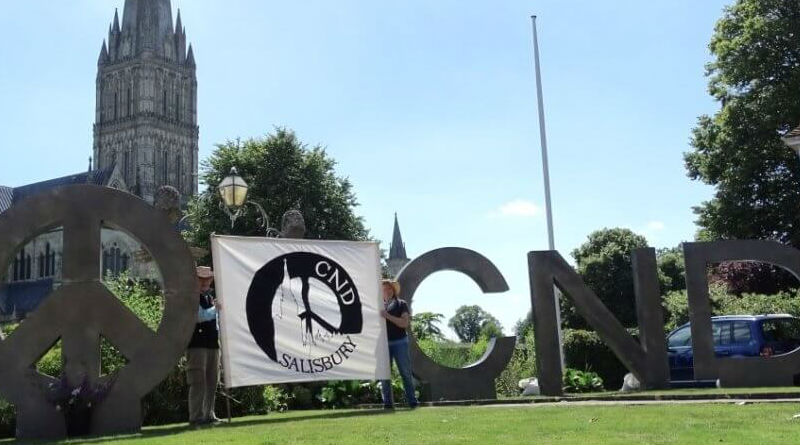
In 2018, to commemorate the 60th birthday of its iconic logo, CND held the Now More Than Ever tour across Britain.
The logo for the Campaign for Nuclear Disarmament (CND) was designed in 1958, the year the organisation held its first ever public meeting.
60 years later, the role of the iconic CND symbol – the internationally recognised peace sign – was used for the Now More Than Ever tour.
A giant three-dimensional symbol installation is visiting dramatic locations across Britain, including the White Cliffs of Dover, Faslane naval base, and the Clifton Suspension Bridge in Bristol.
Between the 12-14 June 2018, the giant CND symbol visited Salisbury and was placed in view of Stonehenge.
The full installation was also placed outside Salisbury Cathedral.
Click here for the CND UK website (opens in a new tab)
Images from cnduk.org