
Campaign Against Torture
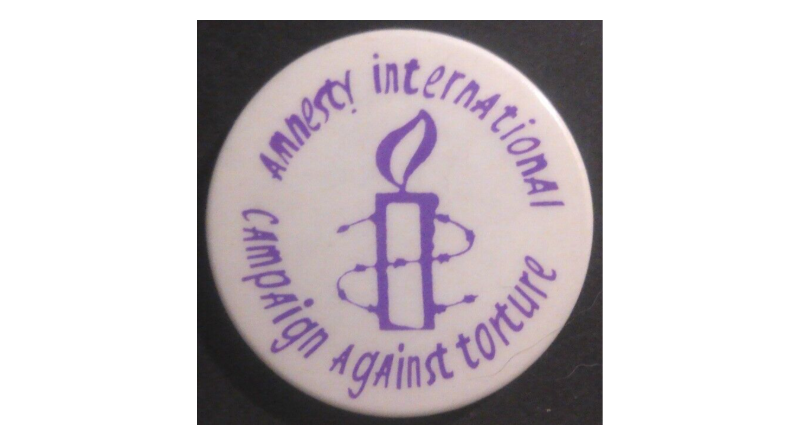
Campaign Against Torture is a purple and white pin badge marking Amnesty International's decision to expand its role into campaigning for the physical safety of prisoners.
The rough purple print
The design of this badge serves as a deliberate visual departure from the organisation's standard authoritative branding. Stamped in a single shade of violet on a white background, the imagery feels urgent, raw, and explicitly hand-drawn. The typeface used for the words Amnesty International and Campaign Against Torture is uneven and organic, lacking the polished, sterile authority of official government communications or corporate letterheads.
By choosing a style that looks less like a formal institution and more like an underground leaflet, the design visually aligns itself with the messy, human reality of grassroots resistance. It mirrors the hurried, clandestine nature of the very testimonies it sought to bring to light.
The logo itself has been stripped down and redrawn to emphasise this harsh reality. The traditional candle is rendered here as a thick, open rectangle, and the flame is reduced to a loose, vulnerable loop of ink. Crucially, the barbed wire does not merely encircle the candle as a distant symbol; it cuts directly across the body of the wax in two sharp, jagged lines. This aggressive abstraction forces the viewer to confront the central conflict of the campaign: the fragile light of a human witness being physically choked by the sharp metal of state machinery, locked in an unyielding vertical struggle.
The global epidemic
This badge belongs to a pivotal moment in human rights history — the 1973 launch of the Campaign for the Abolition of Torture (later renamed to simply Campaign Against Tortue in 1984). Before this date, Amnesty International had focused primarily on 'Prisoners of Conscience,' meaning those jailed solely for their beliefs. But as the 1970s progressed, the organisation began to uncover a disturbing reality: torture was not just a medieval relic or the act of rogue sadists. It was becoming a calculated administrative tool used by modern states to break political dissent.
Sean MacBride, the organisation's chairman at the time, famously described this spread of state-sanctioned violence as an "epidemic." This medical language was deliberate. It framed torture not as a series of isolated crimes, but as a contagion that required quarantine and intervention.
The timing was tragic but essential. In September 1973, while this campaign was active, General Augusto Pinochet seized power in Chile. The subsequent reports of mass detentions in the National Stadium and the systematic abuse of civilians turned the campaign's theoretical fears into a televised reality. This badge represents the shift from a passive legal appeal to an active medical and political intervention.
The invention of urgency
The Campaign Against Torture did more than just raise awareness, it revolutionised the mechanics of protest. It was during this specific campaign that the organisation developed its most famous tool: the 'Urgent Action' network.
The catalyst was the arrest of Luiz Basilio Rossi, a Brazilian professor, in March 1973. When news reached the London office that Rossi was at imminent risk of torture, the secretariat realised that a standard letter-writing campaign, which often took weeks to organise, would be too slow. They needed speed.
In a scramble of administrative improvisation, a staff member grabbed a shoebox full of index cards containing the contact details of reliable activists. They fired off express telegrams and airmail letters, instructing members to flood the Brazilian authorities with immediate protests. The experiment worked; the sudden influx of international attention forced the police to acknowledge Rossi's custody, likely saving his life. This badge symbolises the moment the movement learned that speed was a weapon, and that a swift accumulation of paper could act as a shield against physical violence.
A Nobel result
The work promoted by Campaign Against Torture culminated in a massive accumulation of evidence. In late 1973, to mark the 25th anniversary of the Universal Declaration of Human Rights, the campaign presented a petition with one million signatures to the United Nations General Assembly. This was a physical mountain of paper, signed by individuals from over 90 countries, demanding that torture be outlawed under international law.
With its rough purple ink and jagged wire,, the Campaign Against Torture badge is recognition of the steady, unglamorous duties of documenting violence and collecting testimony. When Amnesty International was awarded the Nobel Peace Prize in 1977, the citation specifically noted this work against torture.