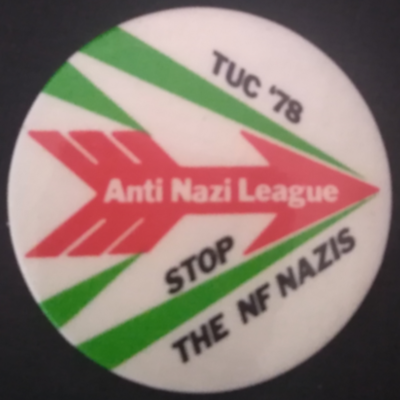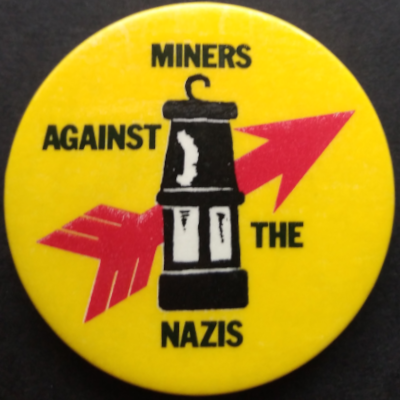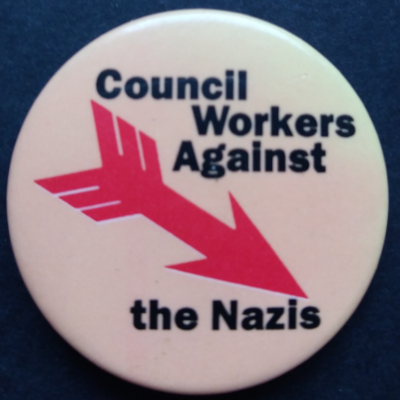
Anti Nazi League
The Anti-Nazi League was a British anti-fascist campaign founded in November 1977 to confront the rising National Front. Backed by trade unions and cultural allies including Rock Against Racism, it organised mass carnivals and leafleting before winding down in 1981. Relaunched in 1992, it merged into Unite Against Fascism in 2003.
Sections
In numbers
4,000–5,000
Anti-fascists at the Battle of Lewisham, Aug 1977
45
Labour MPs signed the founding declaration, 1977
250
Branches at peak, mobilising 40,000–50,000 members
750,000
Badges sold, 1977–79
9 million
Leaflets distributed, 1977–79
£600,000
Raised in individual donations, 1977–80
80,000–100,000
At the first carnival, Victoria Park, Apr 1978
150,000
At the largest carnival, Brockwell Park, Sep 1978
700
Arrested at Southall, Apr 1979 — where Blair Peach was killed
Timeline
-
1977The Battle of Lewisham
Around 4,000 anti-fascists blocked a National Front march through Lewisham, breaking police lines and sparking plans for something bigger.
-
1977The Anti-Nazi League launches
Backed by the SWP, trade unions and public endorsers, the ANL launched to confront the National Front's street presence.
-
1978Carnival Against the Nazis, Victoria Park
An estimated 80,000–100,000 marched from Trafalgar Square to Victoria Park for the first ANL carnival, headlined by The Clash.
-
1978Northern Carnival Against the Nazis, Manchester
Organised in ten weeks, around 40,000 marched from Strangeways to Alexandra Park for a concert featuring Steel Pulse.
-
1978Carnival 2, Brockwell Park
The Brockwell Park carnival drew an estimated 150,000, headlined by Elvis Costello and Aswad, dwarfing a rival National Front rally.
-
1979The anti-election campaign
With the National Front fielding record candidate numbers, the ANL ran a sustained campaign tying NF figures to fascism.
-
1979Southall and the death of Blair Peach
An ANL demonstration at Southall Town Hall turned into clashes with police, and teacher Blair Peach was struck and died.
-
1979The National Front's vote collapses
At the general election, NF support fell far short of expectations, undercutting its claim to be a rising electoral force.
-
1981The ANL winds down
As the National Front fractured and the SWP's priorities shifted, the League stood down, though its badges circulated for years.
-
1992The ANL relaunches
Revived to counter a resurgent far right, this era's badges brought graffiti-style lettering and slogans like 'Smash the BNP'.
-
1993The BNP's Millwall breakthrough
Derek Beackon won a council by-election in Millwall, Tower Hamlets, the BNP's first elected seat, by seven votes.
-
2003Merger into Unite Against Fascism
The ANL formally folded into UAF, its organisational successor, while its badge culture lived on through Love Music Hate Racism.
Brief history
The Battle of Lewisham (1977)
By 1977, the National Front was no longer a fringe party. It had taken 119,000 votes in that year’s local elections, more than the Liberals or the Communist Party managed in the same wards. Its marches were routed deliberately through areas with large Black and Asian communities.
On 13 August 1977, thousands of anti-fascists gathered in Lewisham to block a National Front march of 500 to 600. The march did not reach its planned end. Police used riot shields on the British mainland for the first time. Three months later, the Anti-Nazi League was founded.
The launch of the Anti-Nazi League (November 1977)
Peter Hain and Ernie Roberts, assistant general secretary of the engineering union, built the League on institutional foundations. Roberts brought 45 Labour MPs to sign its founding declaration at that year’s Labour Party conference.
SWP national secretary Jim Nichol coined the League’s name. He also drew in church figures, minority community leaders, and sympathetic journalists. The result combined union backing, parliamentary signatures, and community support in a single campaign.
The street and the stage (1978)
The League worked on two fronts. It distributed nine million leaflets and three-quarters of a million badges in under two years. Working with Rock Against Racism, it also organised mass public carnivals.
Between 80,000 and 100,000 people marched from Trafalgar Square to Victoria Park in April 1978. A further 40,000 marched in Manchester that July, and 150,000 gathered at Brockwell Park in September. The Clash, Steel Pulse and X-Ray Spex performed at these events.
Regional ‘squads’ carried out separate work, stewarding the carnival crowds and meeting National Front gangs directly on the street.
The death of Blair Peach (1979)
In April 1979, Anti-Nazi League activist and teacher Blair Peach joined a demonstration against a National Front election meeting in Southall. He was struck on the head, probably by an officer of the Metropolitan Police’s Special Patrol Group. He died in hospital that night.
Around 700 people were arrested that day. A month later, at the general election, the National Front’s vote collapsed to under 200,000 across more than 300 candidates, and every deposit was lost. The party never recovered the ground it had held two years earlier.
The League stands down (1981)
By 1981, with the National Front fractured, the League formally stood down. Some activists wanted to keep confronting fascists in the street on more militant terms. They were expelled from the SWP and went on to found Red Action, and later Anti-Fascist Action.
The League’s closure did not end debate about its politics. Britain’s Black Power movement, and later the cultural theorist Paul Gilroy, argued that naming the enemy ‘Nazi’ understated the racism built into British policing and immigration policy. Alex Callinicos, for the SWP, dismissed the argument, calling it, “Black nationalist.”
Revival and legacy (1992 - present)
The League returned in 1992 to face a new threat, the British National Party. Rivals dismissed the revival as an exercise in nostalgia. The magazine Searchlight accused the SWP of exaggerating the danger the BNP posed.
The BNP took its first council seat in Millwall in 1993, by a margin of seven votes. The relaunched League ran until 2003, when it merged into Unite Against Fascism.
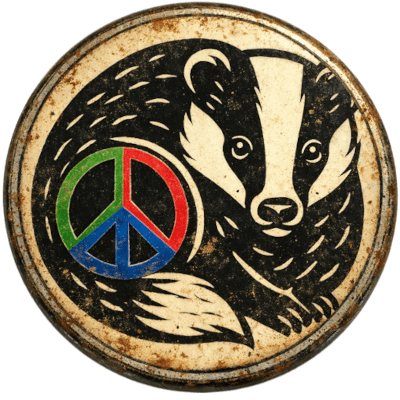
Its badge culture lived on through the Love Music Hate Racism campaign and reissued designs. Unite Against Fascism remains active today, alongside its sister campaign Stand Up To Racism.
The specific fight against the National Front had been won — the wider one it had opened up had not.
Badges
Showing 11 to 13 of 13 total badges