| | by admin | | posted on 13th October 2023 | Artworks | | views 1623 | |
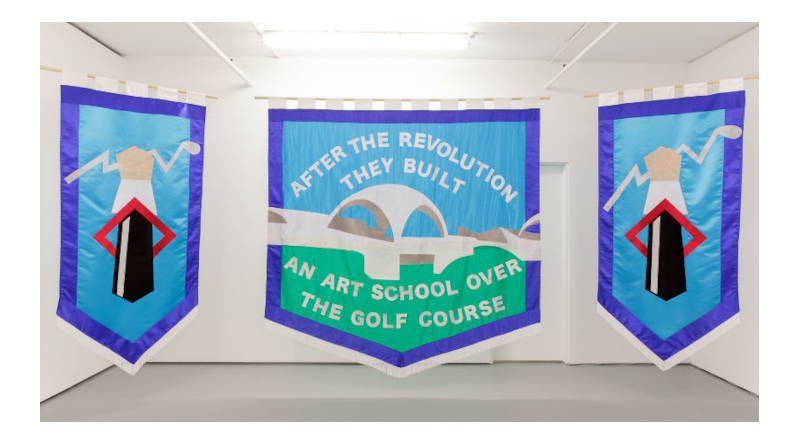
After the Revolution They Built an Art School Over the Golf Course is an artwork by Manchester-based artist Chris Alton reflecting on the Cuban Revolution’s decision to turn an elite golf course into a national school of art.
The title reads almost like a fragment of history. In fact, it refers to a real moment when a landscape of privilege was reimagined as a place for creativity and education.
Alton’s work often explores the relationship between culture, politics and public space. Through banners, text-based works and installations, he draws on the visual language of community halls, social movements and collective gatherings. His artworks often begin with simple statements or phrases that carry a deeper political story.
In this case, the title itself becomes the artwork.
The story behind the work begins in Havana in the early years of the Cuban Revolution.
In 1961, revolutionary leaders Fidel Castro and Che Guevara, according to contemporary accounts, played a round of golf at the Havana Country Club. The course had long been associated with Cuba’s wealthy elite, a carefully maintained landscape that symbolised a world of privilege and exclusion.
Looking across the fairways, the two men reportedly began discussing how such spaces might be used differently in a new society.
Their conclusion was simple and striking. The golf course would not remain a playground for the rich. Instead, it would become a place for art.
Soon afterwards, the Cuban government announced plans to build a national complex of art schools on the site.
The new Escuelas Nacionales de Arte, or National Art Schools, were conceived as a centre for artistic education open to students from Cuba and beyond.
The project reflected the optimism of the early revolutionary years, when culture and education were seen as essential to building a new society.
Students would come to study music, dance, theatre and visual art on land previously reserved for leisure and status.
Although the schools were never fully completed, the campus still functions today and is widely regarded as one of the most remarkable cultural projects of the Cuban Revolution.
Chris Alton’s artwork reflects on the symbolic power of that transformation.
A golf course represents a particular kind of landscape: wide green spaces designed for leisure, exclusivity and social status.
Replacing that landscape with a school of art suggests a very different set of priorities.
Creativity instead of privilege.
Culture instead of status.
Shared learning instead of private leisure.
Raised in a Quaker family and active within the Quaker community, Alton’s work often reflects themes of social justice and collective responsibility. His projects frequently explore how cultural symbols and public spaces can be reimagined.
“Whether deploying disco music in opposition to fascism, recording a rhythm and blues album about tax avoidance, or proposing art schools be built over golf courses, my work addresses the interconnected nature of social, political, economic and environmental conditions.”
What once symbolised privilege became a place for creativity and learning. A landscape designed for leisure and exclusion was reimagined as a space where art, music and ideas could flourish.
Alton's work captures that moment of transformation in a single line of text. It reminds us that revolutions are not only fought in streets and parliaments, but also expressed through the way societies reshape their cultural spaces.
Sometimes the most powerful political statements are not speeches or slogans, but decisions about what a landscape should become.