200 cities for peace
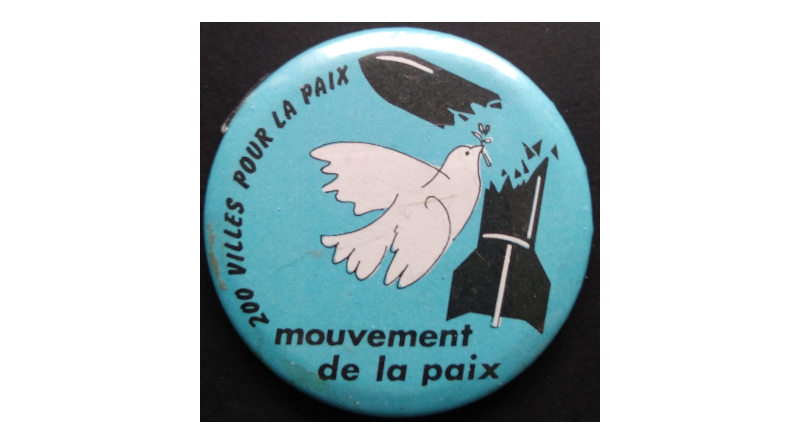
200 cities for peace is a badge represents a moment when local communities, both in France and beyond, decided to ban the arms race from their own streets.
Mapping peace town by town
The text curving across the top of the badge reads 200 villes pour la paix (200 cities for peace). During the 1980s Euromissile crisis, as new medium-range nuclear missiles were deployed across Europe, activists looked to their local geography to push back against the Cold War. This strategy pulled the threat of international warfare down to the level of municipal planning.
The badge celebrates a specific milestone: the moment 200 French municipal councils passed official declarations designating their towns as nuclear-free zones. These local governments publicly rejected the military policies of the era, refusing to allow the transport, storage, or manufacture of nuclear weapons within their city limits.
The movement behind the badge
The text along the bottom of the pin identifies the driving force behind this effort, printing its name in simple lowercase as mouvement de la paix (the Peace Movement). Founded in 1948 in the aftermath of the Second World War, it grew to become the primary peace organisation in France.
The movement was built by former partisan fighters. Having survived the Nazi occupation, these founders brought a hardened physical resolve to their work. Supported by trade unionists, Christians, and the French Communist Party, the group had the structural power and local networks required to mobilise against the nuclear arms race on a massive scale.
The Picasso connection
To represent this resistance, the badge uses a striking visual adaptation of high art. Against the bright blue background, a white dove flies directly through the casing of a black bomb, shattering the weapon into jagged pieces.
The original dove emblem was created in 1949 by Pablo Picasso, who granted the French movement permanent permission to use his work. Because Picasso died in 1973, well before the missile deployments of the following decade, badge designers took one of his authorised line-art doves and graphically altered it. The smooth lines of the bird cut straight through the heavy, industrial geometry of the modern rocket, turning a quiet messenger into an active physical force.
A cross-channel blueprint
While the badge and its origins are distinctly French, the municipal strategy it celebrates was sparked across the English Channel. In November 1980, Manchester City Council became the first local authority in the UK to declare itself a nuclear-free zone, setting a practical blueprint for local resistance.
By 1982, over 150 British councils had adopted similar resolutions. French towns taking part in the initiative were frequently twinned with British counterparts, such as Coventry, building a physical network of solidarity across borders.
A continuing practice
The formal organisation, the Mouvement de la paix, remains active today, continuing its methodical work against nuclear armament. The group still focuses on municipal action, currently working to encourage French local authorities to publicly support the UN Treaty on the Prohibition of Nuclear Weapons.
This badge survives as a record of when that local strategy first gained ground. It is a piece of pressed tin capturing a moment when hundreds of communities attempted to anchor the concept of peace directly into the map of Europe.